Period Pain and Work: The Days She Cannot Call In Sick
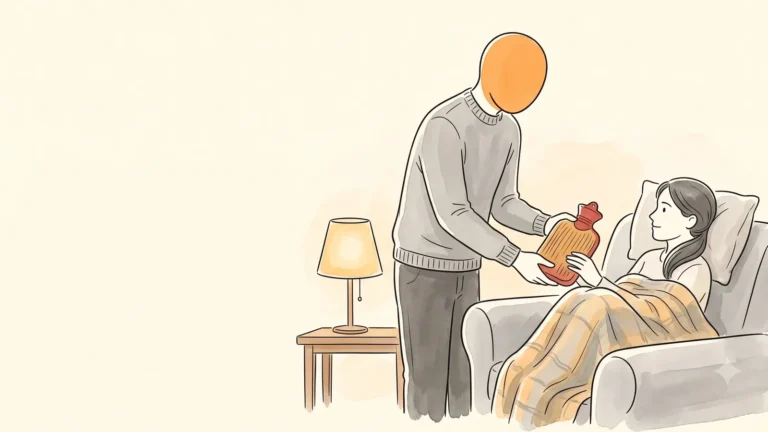
She was on a video call at 9am with a hot water bottle under the desk, out of frame, sitting very still. Afterwards she said the call went fine. It probably did. What I worked out later is that she had been awake since four and had already decided at six that going in was cheaper than explaining why she wasn’t.
Period pain and work is the part of this that partners see least, because by definition she is somewhere else while it happens. The version you get is the wreck who walks in at seven, and it is easy to read that as a bad evening rather than the end of a bad twelve hours.
Nine days a year, and only one of them is a sick day
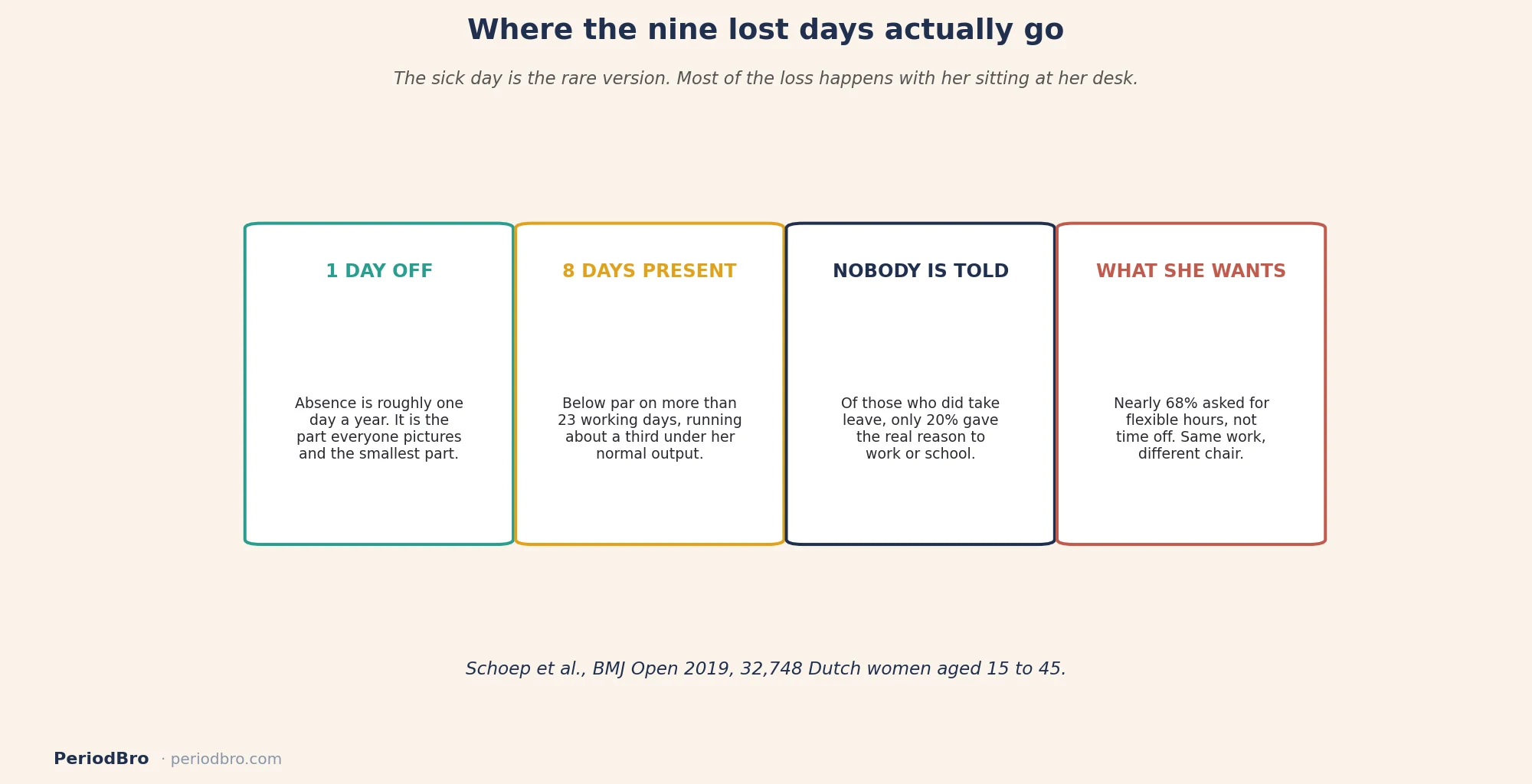
The biggest study on this looked at 32,748 Dutch women aged 15 to 45 and was published in BMJ Open in 2019 (Schoep et al.). It found around nine days of productivity lost per person per year to menstrual symptoms.
Where those nine days come from is the useful bit. Roughly one of them is absence. The other eight are days she was at work, at her desk, in the meeting, getting through it at maybe two thirds of normal. Across the sample, women reported being below par on more than 23 days of the working year, running at about 33% below their usual output on those days.
Most of us carry a mental model where a bad period means a sick day, and it is backwards. The sick day is rare. The common version is her being present and quietly halved, which shows up in no system anywhere.
Why she goes in anyway
In that same Dutch sample, about 14% had taken time off during their period at some point. Of those, only 20% told their employer or their school the real reason.
Four out of five invented something instead. A migraine, a stomach bug, a vague “not feeling great”, whatever the workplace was likely to accept without a follow-up question.
That is arithmetic rather than fragility. Saying “my period” once buys you a day and a reputation, and saying “migraine” just buys you a day. Nearly 68% of the same group said they wanted more flexible hours during their period, which suggests what they actually want is to do the work at a different hour, from a different chair.

What the bad hours actually consist of
A 2025 US survey of 372 full-time working women, average age 33, asked what specifically got worse (full text). During the bleed and pre-bleed days, the top hit was energy, reported by 81.4%. Then mood at 58.8%, concentration at 53.2%, interest in the work at 42.4%. Nearly a fifth said it affected how they got on with colleagues.
The symptom list underneath it was fatigue at 86.6% and cramps at 86.3%, running neck and neck.
Energy and concentration outrank the pain in that ordering, which changes what actually helps. Painkillers and a hot water bottle address the cramps. Nothing in your kitchen addresses running a full day of meetings on four hours of sleep with no reserve, which is why “did you take something?” lands so badly as an opener. It answers a question she did not ask.
For what it’s worth, only 4.6% of those women said their employer offered anything at all in this area.
The morning is where you can actually do something
Most of us aim at the evening, by which point the day has already happened. These are the things that change it before she leaves.
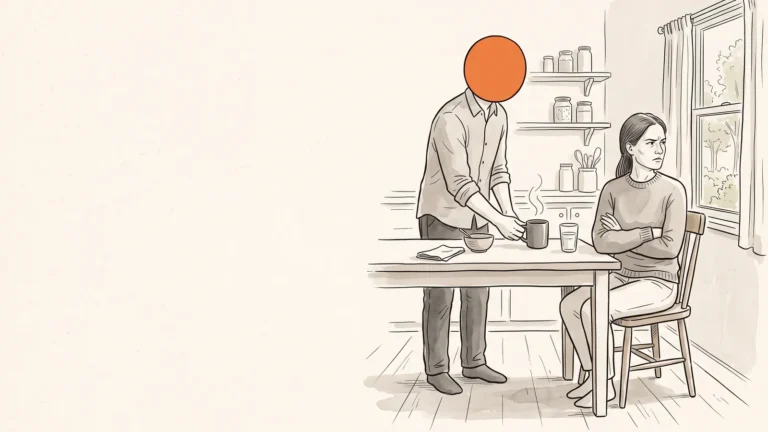
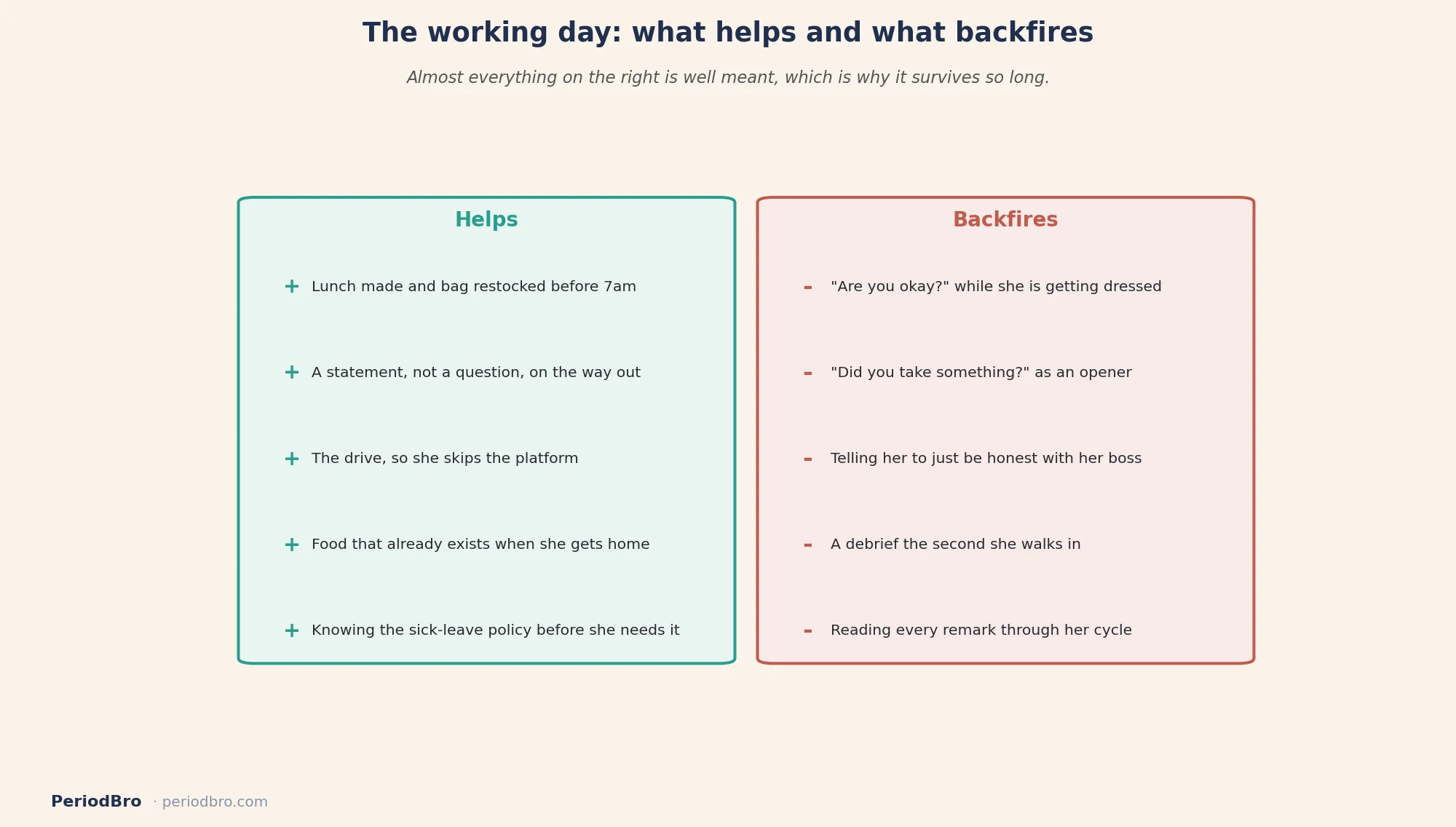
Handle the logistics silently. Lunch made, coffee ready, the thing she needs to drop off already in the car. Every task you take off the morning is an hour of energy that survives to 3pm.
Do not open with a question. “Are you okay?” at 7am forces her to assess and report while getting dressed. “I’ve packed you a lunch and there is paracetamol in the side pocket” delivers the same care with no admin attached.
Restock the bag, not just the bathroom. Products, spare underwear, painkillers, something to eat. In the bag she actually carries, topped up by you, so the question of whether she has enough never has to be asked on a train. There is more on the mechanics of that in what to do when she bleeds through.
Offer the drive if you have one to offer. Twenty minutes not standing on a platform is a real intervention on day two.

The evening, and the mistake I kept making
My version of getting this wrong was treating her walk through the door as the start of a conversation. She had spent nine hours performing normal. The last thing she had capacity for was a debrief about how hard that had been.
What works better is boring and physical: food that already exists, the heating on, nothing scheduled and no decisions requested. Including small ones, because “what do you want to eat” is a decision and she has been rationing those since four in the morning. If you want a longer list of what to cook and why it matters more than it sounds, we wrote that one separately, and the harder days have their own guide in the worst day of her period.
If she does want to talk about the day, keep it about the day rather than about her cycle. Reading everything she says through the lens of what week it is gets old fast, and there is a whole piece on why that backfires in is she mad at me, or is it her period. The same goes for the plans that quietly disappear in that week, which we covered in when she cancels plans.
Whether she tells them is not your decision
At some point most partners have the same impulse: she should just be honest with her manager. It sounds like advocacy. From where she sits it usually reads as you volunteering her for a risk you do not carry.
She is the one who has to work with those people afterwards. She is the one who knows whether her manager is the sort who files it under “health thing, fine” or the sort who quietly starts factoring it into who gets the big account. The 80% who invent a migraine are not being cowardly, they are pricing in a workplace they know better than you do.
The useful position here is a narrow one. Back whatever she decides, out loud. If she wants to tell them, help her work out the sentence. If she does not, never suggest she is making it harder than it needs to be. And if her workplace does have a policy, sick leave, flexible hours, working from home, know what it says before she has to go looking for it at six in the morning with a hot water bottle on her lap. That is a twenty minute job you can do on a normal Tuesday.
Period pain and work: when it becomes a medical question
Some of this is ordinary and some of it is a signal, and the line is more concrete than people think.
Cleveland Clinic puts heavy menstrual bleeding at 27% to 54% of people who menstruate, and gives usable markers: periods longer than seven days, soaking a pad or tampon every hour for several hours, doubling up on products, getting up at night to change, clots the size of a quarter several times a day. Bleeding through two or more products an hour for two to three hours running is an urgent-care threshold, not a work-from-home problem.
Pain has its own line. Pain that reliably takes her out of a working day, month after month, is not something to out-tough. That is the picture that gets called endometriosis years later than it should be, and the average delay in getting there is measured in years partly because everyone involved keeps filing it under a rough week. Is her period pain normal walks through where that line sits.
And if she is exhausted rather than just sore, that is worth its own look. Heavy bleeding drains iron, and low iron is felt at 3pm on a Wednesday long before it shows up as anemia on a routine test. We covered the mechanism in iron deficiency from heavy periods.
The one thing worth building
Knowing which week it is turns out to be most of this. Not to manage her, and not to explain her to herself, but so that the big client dinner does not get scheduled on day two by accident, and so the fridge is stocked before rather than after.
I built PeriodBro to do exactly that from my side, without asking her to install anything or narrate her symptoms to an app for my benefit. A quiet heads-up a couple of days out is enough to change what the morning looks like. The wider version of the same habit is in being a better partner through her cycle.
She still goes to work on the bad days. Almost everyone does. The part you get a say in is what she has to carry there and what she walks back into.

Medical disclaimer: this is general information, not medical advice. Period pain severe enough to stop a working day, bleeding heavy enough to soak through two or more products an hour, or exhaustion that does not lift are all worth a conversation with a clinician rather than a better hot water bottle.