
Birth Control and Her Cycle: What Actually Changes
If your partner is on the combined pill, the bleed she gets every month is a withdrawal bleed rather than a period. It is her body responding to a few days off the hormones, and it exists largely because the pill was designed to look like a natural cycle. Once you know that, a lot of what birth control and her cycle do together starts making sense.
I spent an embarrassing amount of time tracking a partner’s cycle before I understood this. I was watching a calendar and drawing conclusions from it, and half of what I thought I was seeing was not there.
The bleed on the pill is not a period
Combined hormonal contraception works by suppressing ovulation. UK guidance from the Faculty of Sexual and Reproductive Healthcare is blunt about what the resulting monthly bleed is: it “does not represent physiological menstruation” and “has no health benefit.” Cleveland Clinic says the same in plainer language, noting there is no medical reason a withdrawal bleed needs to happen, and that manufacturers designed it to mimic a natural cycle.
It usually looks like a lighter, milder version of a period, running roughly four to seven days, because the uterine lining never thickens the way it does in an ovulatory cycle.
None of this means her experience is fake. Cramps, mood shifts and fatigue around that week are still real things happening in her body. It means the underlying machinery is different from the one described in the standard menstrual cycle guide, and applying the standard model to it will mislead you.

What changes depends entirely on the method
Lumping all birth control together is the second mistake. The bleeding pattern differs sharply by method, and the differences are documented in the product labelling.
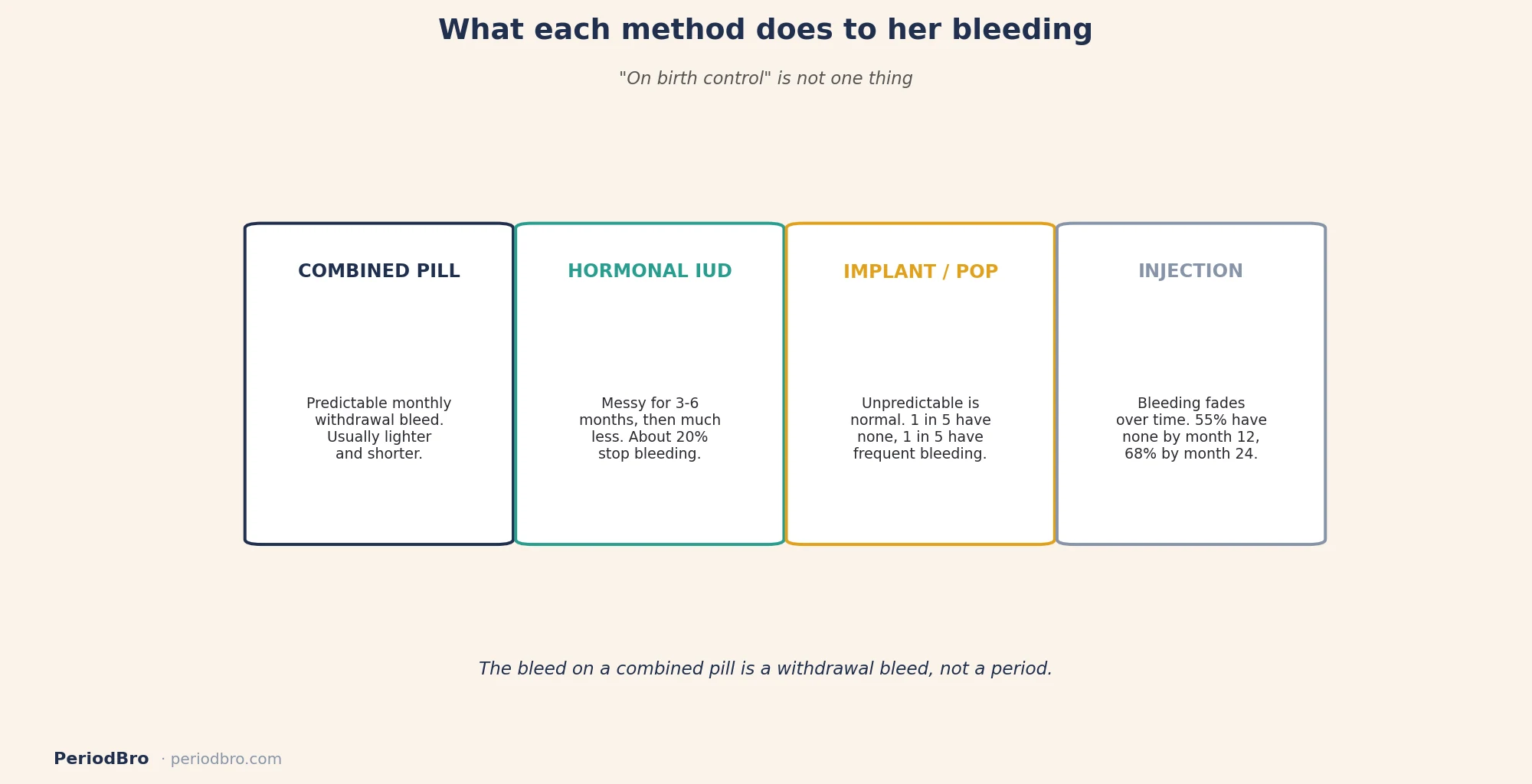
Combined pill, patch, ring. Predictable monthly withdrawal bleed, usually lighter and shorter than her natural period.
Hormonal IUD. The first three to six months are often messier, with more bleeding and spotting days and an irregular pattern. Then it settles, usually into much less. The Mirena labelling reports that around 20% of users have no periods at all by one year, and an independent trial of 1,714 women found roughly 17% with no bleeding or spotting over the preceding 90 days at the twelve month mark. For heavy bleeding it is used as a treatment in its own right, with blood loss more than halved in nearly 9 out of 10 women in the trials.
Implant and progestin-only pills. Unpredictable is the norm rather than the exception. With the implant, about 1 in 5 women have no bleeding and about 1 in 5 have frequent or prolonged bleeding, averaging 17.7 bleeding or spotting days per 90 days. One useful detail from the labelling: the pattern in the first three months broadly predicts the pattern later, so an unpleasant start is information rather than just a bad spell.
The injection. Bleeding tends to stop over time. By month 12 around 55% report no periods, rising to 68% by month 24.
Cramps usually get better, and there is a number for it
A 2023 Cochrane review pooling 21 trials and 3,723 women looked at combined pills for period pain. On the responder measure, 47% improved on the pill against 28% on placebo, though the certainty on that comparison was rated low. On the continuous pain score the evidence was rated high certainty, with a reduction of roughly 0.7 to 1.3 points on a six point scale.
So: a real improvement, not a miracle, and a meaningful minority get little from it. If her cramps have not improved on the pill, that is a documented outcome rather than her doing something wrong.
Skipping the bleed is a legitimate option
Since the monthly bleed is not medically required, running packs back to back to skip it is a real choice. FSRH says the standard 21 day on, 7 day off pattern was designed to mimic a natural cycle, that there is no health benefit to a monthly withdrawal bleed, and that the safety data on extended regimens is reassuring, with very few serious adverse events in trials comparing the two.
The honest caveat is that unscheduled spotting is common on extended use. Cleveland Clinic’s framing is the right one: usually safe, still worth talking to her clinician about first.
Why anyone would bother: FSRH notes the hormone-free week can bring bleeding that is heavy, painful or simply unwanted, and can come with headaches and mood changes. If her worst week every month is the placebo week, there is something to discuss.
Mood and libido, without the scare story
This is where I would ask you to resist a confident opinion in either direction.
The study everyone cites is a Danish cohort of just over a million women, published in JAMA Psychiatry in 2016. It found higher rates of starting antidepressants among hormonal contraception users: a relative risk of 1.23 for the combined pill, higher for progestin-only pills and the hormonal IUD, and notably higher in 15 to 19 year olds at 1.8 for the combined pill.
Now the absolute numbers from the same paper, which rarely get quoted: 2.2 first antidepressant prescriptions per 100 person-years among users against 1.7 among non-users. That is a real difference and a small one. The authors listed selection bias, detection bias and confounding among their own limitations.
Pulling the other way, a network meta-analysis of randomised trials covering 5,833 participants found essentially no effect on depressive symptoms, with a median standardised mean difference of −0.04. The certainty of that evidence was rated very low. FSRH’s own read is that most observational studies are reassuring and that causation is not established.
On libido, a review of 36 studies covering 8,422 pill users found 21.7% reported increased desire, 63.6% no change, and 15% a decrease. Most people notice nothing.
The useful conclusion is not “birth control causes depression” and not “it is all in her head.” It is that a minority of people do feel worse on a given method, that this is worth taking seriously as her experience rather than arguing with, and that switching methods is a normal thing to discuss with a clinician.

The one safety item worth knowing
If she gets migraine with aura, meaning visual disturbance, tingling or speech changes before the headache arrives, that matters. US Medical Eligibility Criteria classify migraine with aura as Category 4 for combined hormonal contraception, which means an unacceptable health risk, for both starting and continuing. A CDC-authored analysis of nearly 26,000 ischaemic strokes in women aged 15 to 49 found migraine with aura combined with hormonal contraception carried an adjusted odds ratio of 6.1 compared with neither exposure.
Two things belong next to that. First, the absolute risk stays low: ischaemic stroke in women of reproductive age runs at roughly 3.6 per 100,000 per year. Second, progestin-only methods and the hormonal IUD are Category 2 and remain options, so this is a reason to switch method rather than a reason to panic. Migraine without aura is a different and much less restricted situation. New or worsening headaches after starting combined contraception are worth a medical review. If migraines are part of the picture at all, menstrual migraines is the companion read.
What is still worth tracking
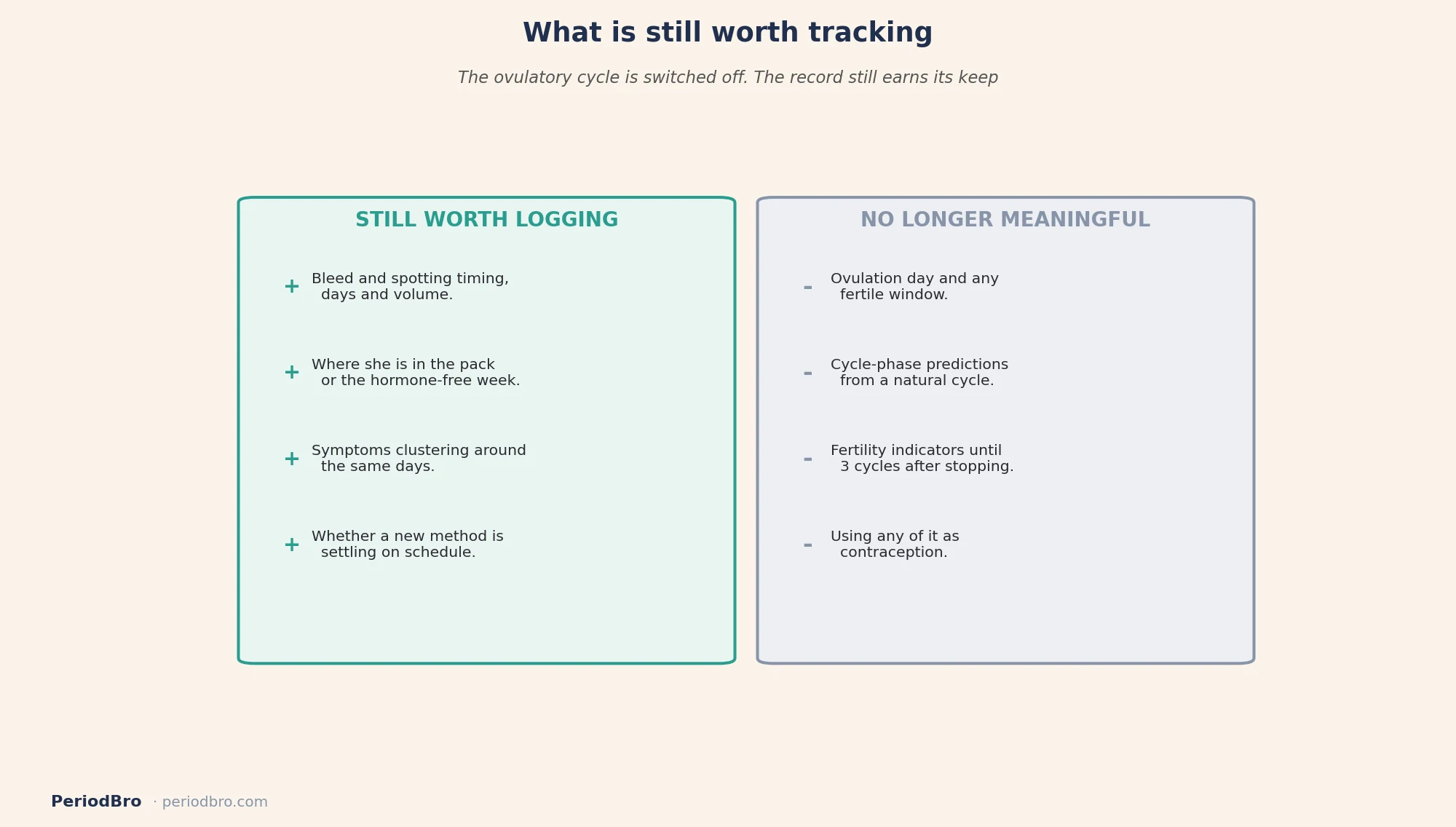
If she is on a method that suppresses ovulation, ovulation and the fertile window are not trackable. There is no cycle day to predict because there is no ovulatory cycle running underneath.
Plenty is still worth logging. Bleed and spotting timing and volume, which is exactly the outcome the clinical trials measure. Where she is in the pack. Symptom patterns around the hormone-free week. Whether the first three months on an implant or the first six on an IUD are settling the way they are supposed to. That last one is genuinely useful, because “is this normal yet” is answerable from a record and not from memory.
The obvious line, said plainly: none of this is contraception, and a tracker is not a birth control method. It is a record that makes appointments and support easier. The consent side of that is covered in tracking her cycle without being creepy.
Coming off it
Combined methods are not associated with a delay in fertility returning. Most people ovulate within about a month of stopping, and in one study 98.9% of women resumed periods or conceived within 90 days. With the implant, pregnancies have occurred as early as 7 to 14 days after removal. After a hormonal IUD, the chance of conceiving within 12 months of removal is around 80%.
The injection is the exception and it is a big one. Median time to conception after the last shot is 10 months, with a range from 4 to 31 months. That is worth knowing well before anyone is trying.
One more, for anyone planning to read the cycle again afterwards: FSRH advises not relying on fertility indicators until regular cycles are re-established and at least three cycles have passed since stopping. Expect the first few to be unrepresentative, which is also why a late period right after stopping is usually not the story it looks like.
Knowing which of these applies to her turns a confusing month into a predictable one, which is the entire reason I built a tracker for partners in the first place.
This article is general information, not medical advice, and PeriodBro is not a contraceptive. Method choice, skipping withdrawal bleeds, and any change to contraception should be discussed with a clinician. Unexpected or persistent bleeding, and new or worsening headaches after starting combined contraception, warrant medical review.