

Flo for Partners vs the Alternatives: An Honest Review (2026)
If you’ve poked around your partner’s cycle app, you’ve probably seen it: Flo has a partner mode now. So do a handful of others. The pitch is always the same, that you’ll finally understand what she’s going through. The question nobody answers straight is whether these things are actually built for you, or just bolted onto an app built for her.
This is an honest Flo for Partners review, plus a look at the real alternatives. I build one of these apps, so treat that as disclosure, not a sales pitch. I’m going to tell you where Flo is genuinely enough, and where it isn’t, because the useful thing here is knowing what you’re choosing between.
How partner mode actually works (three different models)
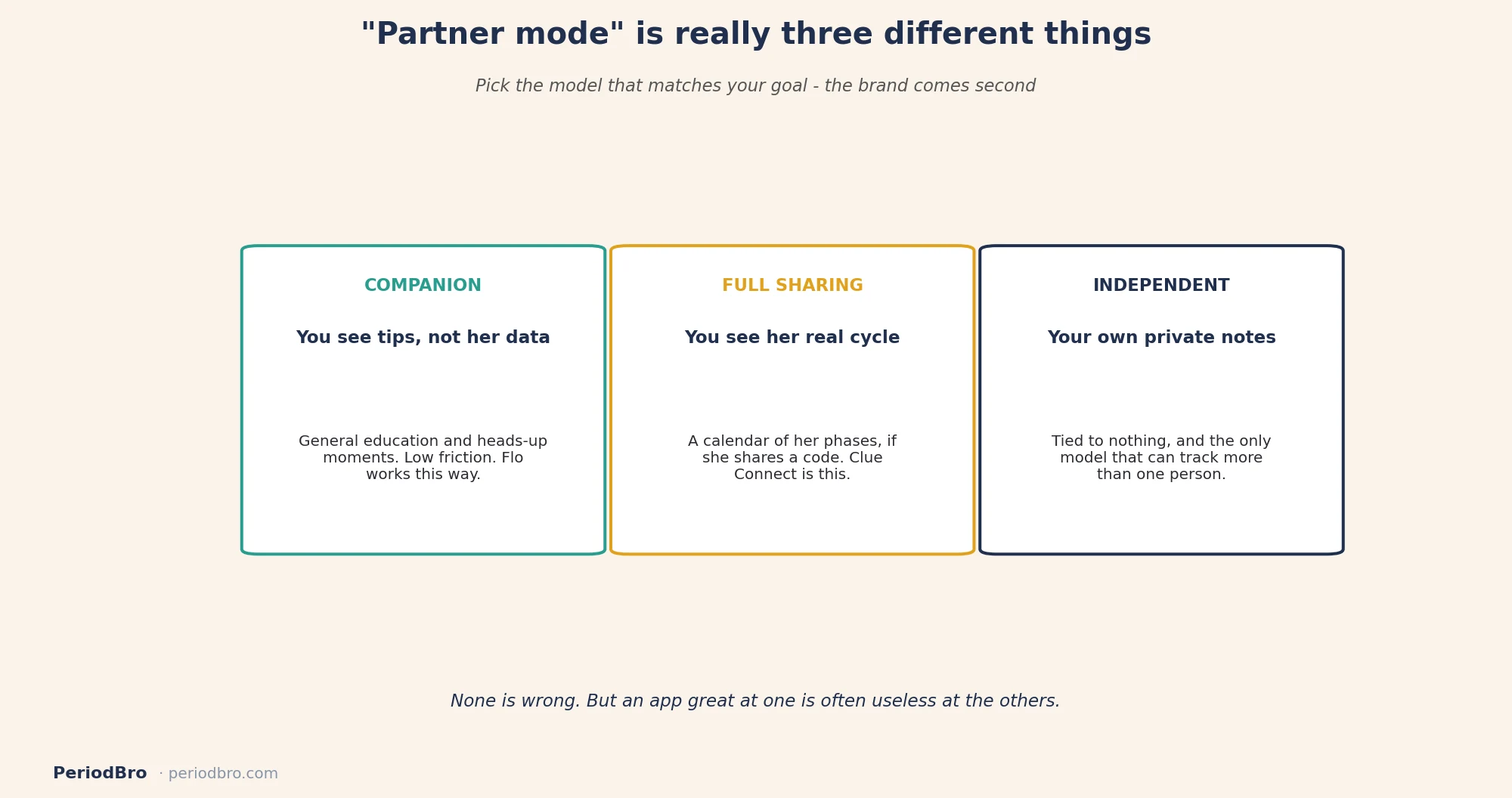
Before comparing brands, it helps to see that “partner mode” isn’t one thing. There are three models under the hood, and which one you want depends on what you’re trying to do.
The first is companion mode. You get your own view with tips and general education, but you don’t see her actual data. Flo works this way. The second is full sharing, where she grants you a window into her real cycle, usually a calendar of phases. Clue Connect is this. The third is independent tracking, where you keep your own notes on your own phone, tied to nothing. That last one sounds lonely until you realize it’s the only model that also lets you track more than one person, which matters if you’re also a dad.
None of these is wrong. But an app that’s great at one is often useless at the others, and the marketing rarely tells you which model you’re buying.
Flo for Partners review: what’s good, where it stops
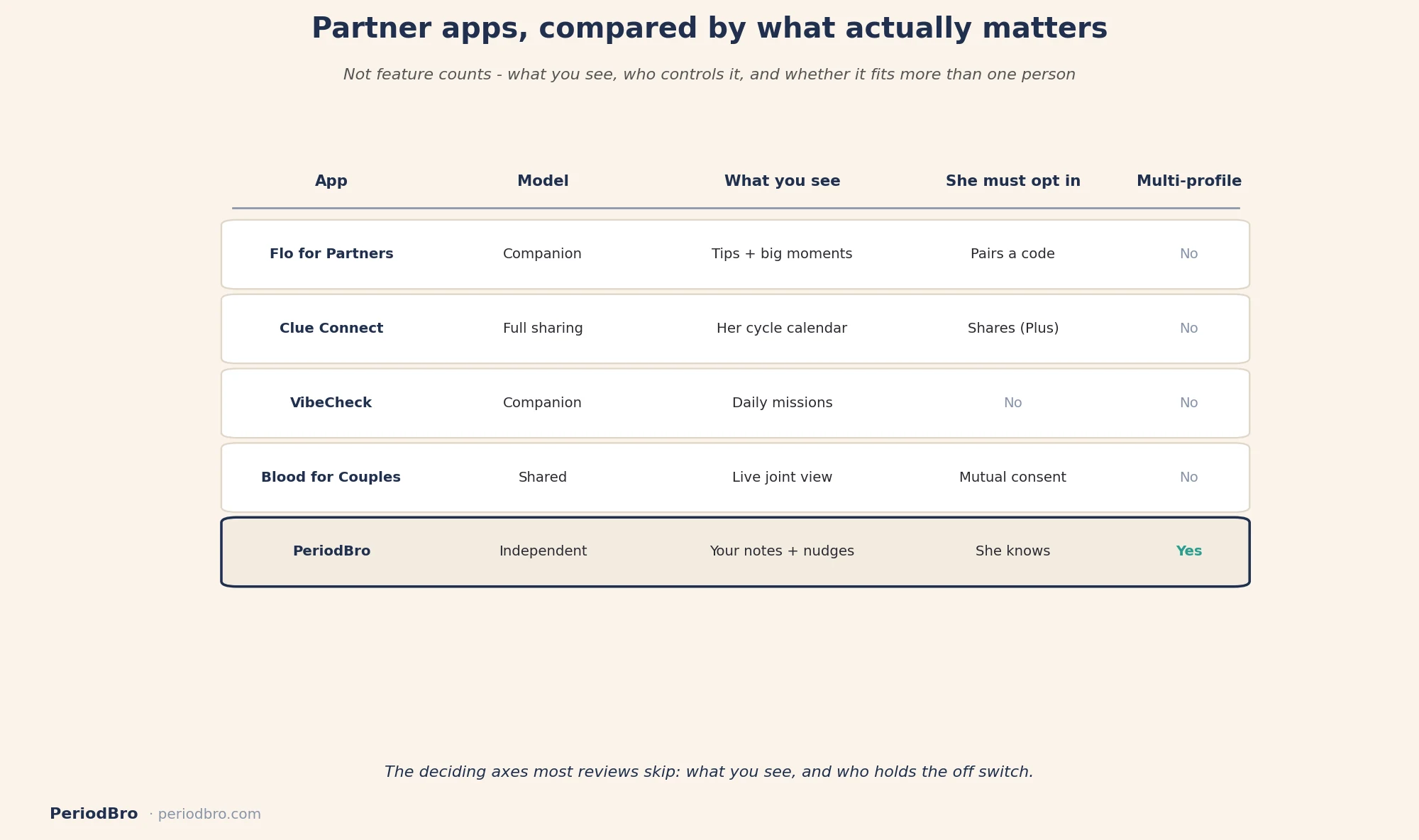
Here’s how it works. Inside her Flo app she opens the Partner tab, taps to link a partner, and the app generates a pairing code. You download Flo, choose “I am a partner,” and enter the code. From then on you get short daily stories about where she is in her cycle, when ovulation is likely, and, if she’s pregnant, how things are progressing week by week. Basic tracking is free for both of you; the deeper articles, tailored insights, and extra content sit behind Flo Premium. You have to be 18 to use it.
What’s good: it’s low-friction, it’s medically reviewed, and the education is solid. If your goal is “help me understand the general shape of a cycle and get a heads-up on the big moments,” Flo for Partners does that cleanly, and you already know she trusts the app.
Where it stops: it’s companion-mode by design, so you’re mostly seeing generic education rather than her specific pattern. It assumes one relationship, one direction. And it lives inside Flo, a company whose data practices drew enough scrutiny that privacy is a fair thing to weigh, especially now. For a lot of guys, Flo is genuinely enough. If that’s you, stop reading and go pair it. If you want more control over your own side, keep going.
Clue Connect, VibeCheck, and Blood for Couples, briefly and honestly
Clue Connect is the cleanest full-sharing option. She shares an invite code and you see her cycle phases, period days, fertile window, and PMS, laid out in a simple calendar. You don’t see her moods, energy, or pain notes, which is a respectful default. The catch: for her to share, she needs Clue Plus, the paid tier. Viewing on your end is free. It’s calendar-first, so it tells you where she is but not much about what to do.
VibeCheck leans into the “for men” angle with daily missions and prompts. Some guys like the gamified nudges. The tradeoff is that it’s very much selling you a version of yourself, and it’s one-person, one-relationship like the rest.
Blood for Couples is the most shared of the bunch, a real-time dashboard both of you look at, with built-in care messages, gated behind mutual consent. If you’re both bought in and want a joint tool, it’s a good fit. It’s also, by design, a two-person shared thing, so it’s not what you want if you’d rather keep your own quiet notes or track a daughter too.

The consent question nobody asks: who controls the access
Every review argues about features. Almost none of them ask the question that actually matters in a relationship: who owns the connection and can shut it off. In companion mode she’s not sharing data, so there’s nothing to control. In full sharing, like Clue Connect, she holds the code and can revoke it, which is exactly how it should be. In independent tracking you’re keeping your own observations, which is fine as long as she knows you do it. That last part isn’t optional. Tracking her cycle without telling her is the move that turns support into surveillance, and I’ve written before about tracking without overstepping.
So the real axis of comparison isn’t “how many features.” It’s what you see and who controls it. A tool that shows you everything but hides who’s in charge is a worse choice than a simpler one where the answer is obvious.
Privacy in a post-Roe world
This used to be a footnote. It isn’t anymore. Cycle data can reveal pregnancy, loss, and timing, and in the current legal climate in the US that’s information worth being careful with. When you’re choosing a partner tool, it’s fair to ask three plain questions: where does the data live, who can see it, and can it be deleted. Apps that keep sensitive data on the device, or that let her delete everything on demand, are structurally safer than ones that pool it in an ad-funded cloud.
Flo has publicly leaned into privacy features in recent years, partly in response to earlier criticism, so it’s better than it was, but it’s still a large cloud service. Clue is EU-based and has a long privacy track record. The honest point isn’t to scare you, it’s that “who holds the data” belongs on your checklist next to features, not buried under it. If a company’s answer to those three questions is vague, that’s your answer.
This matters double if you’re the one setting up the tracking, because you’re effectively vouching for the tool. Pick one you’d be comfortable explaining to her in full.
Which one fits you
If you want light education and she already loves Flo, use Flo for Partners. If you want to actually see her cycle and she’s up for sharing, Clue Connect is the honest pick. If you both want a joint dashboard, Blood for Couples. If you want to keep your own notes, get daily “here’s what would help today” nudges instead of raw data, and track more than one person, that’s the gap the others leave open, and it’s the one I built an app built for your side to fill.
There’s no universal winner. There’s the model that matches what you’re trying to do. Most guys pick the app first and figure out the model by accident. Do it the other way around.
For what it’s worth, the reason I ended up building instead of just installing something was boring: I wanted to keep my own light notes, get a nudge on the days that would be hard, and eventually track a second person, and nothing on the shelf did the third part without treating it like surveillance. If your needs stop at “understand her better,” you have good options above and you don’t need mine. If they don’t, at least now you know why the shelf feels incomplete.

FAQ
Is Flo for Partners free? Basic tracking is free for both people. The richer articles and tailored insights require Flo Premium.
Does she have to install anything? For Flo and Clue, yes, she’s the one who generates the code, so she has to be on board. For an independent tracker, no, but you should still tell her you’re keeping notes.
Is it even ethical to track her cycle? Yes, when she knows and it’s in service of showing up better. It stops being ethical the moment it’s secret or used to win arguments. The whole point is understanding, not leverage. If you want the fuller version of that thinking, here’s how cycle awareness can make you a better partner.
The honest bottom line
Flo for Partners is a solid companion tool and often all you need. The alternatives each solve one specific job better: Clue for seeing her cycle, Blood for a shared view, and an independent multi-profile tracker for keeping your own notes across more than one person. Pick the model, then the app. That’s the whole trick.
This is a product comparison, not medical or legal advice. App features and pricing change, so confirm the current details before you commit. Nothing here is a substitute for talking to her directly.