
Period Dizziness: Why She Feels Lightheaded Around Her Period (and How to Help)
She stood up from the couch to grab a glass of water, took two steps, and put her hand flat on the wall. Just for a second. “I’m fine,” she said, before I’d even asked. But she sat back down, and her face had gone a little pale. It was the first day of her period, and I remember thinking the same useless thought I’d thought about a dozen of her symptoms before I bothered to learn anything: is that normal?
It turns out it usually is. Feeling lightheaded, woozy, or like the room tipped for a moment is a real and common thing for a lot of people around their period. It isn’t drama, and it isn’t her being delicate. There are a few specific, physical reasons her body does this, most of them tied to the same hormone shifts that drive cramps and fatigue. Knowing what’s behind it changes you from the guy who says “drink some water” on autopilot to the partner who already had the water poured.
What period dizziness actually is
Period dizziness is that lightheaded, floaty, or off-balance feeling that shows up in the days right before or during her period. Some people describe it as the room spinning, some as nearly fainting when they stand up too fast, some as a vague wooziness that comes and goes for a day or two. It clusters around the start of bleeding because that’s when the biggest hormonal and physical changes hit at once.
The honest version is that there usually isn’t one single cause. It’s a handful of things that overlap during the same window, and which one is loudest changes from person to person and month to month. So instead of looking for the reason, it’s more useful to understand the short list of usual suspects.

The four things that make her lightheaded
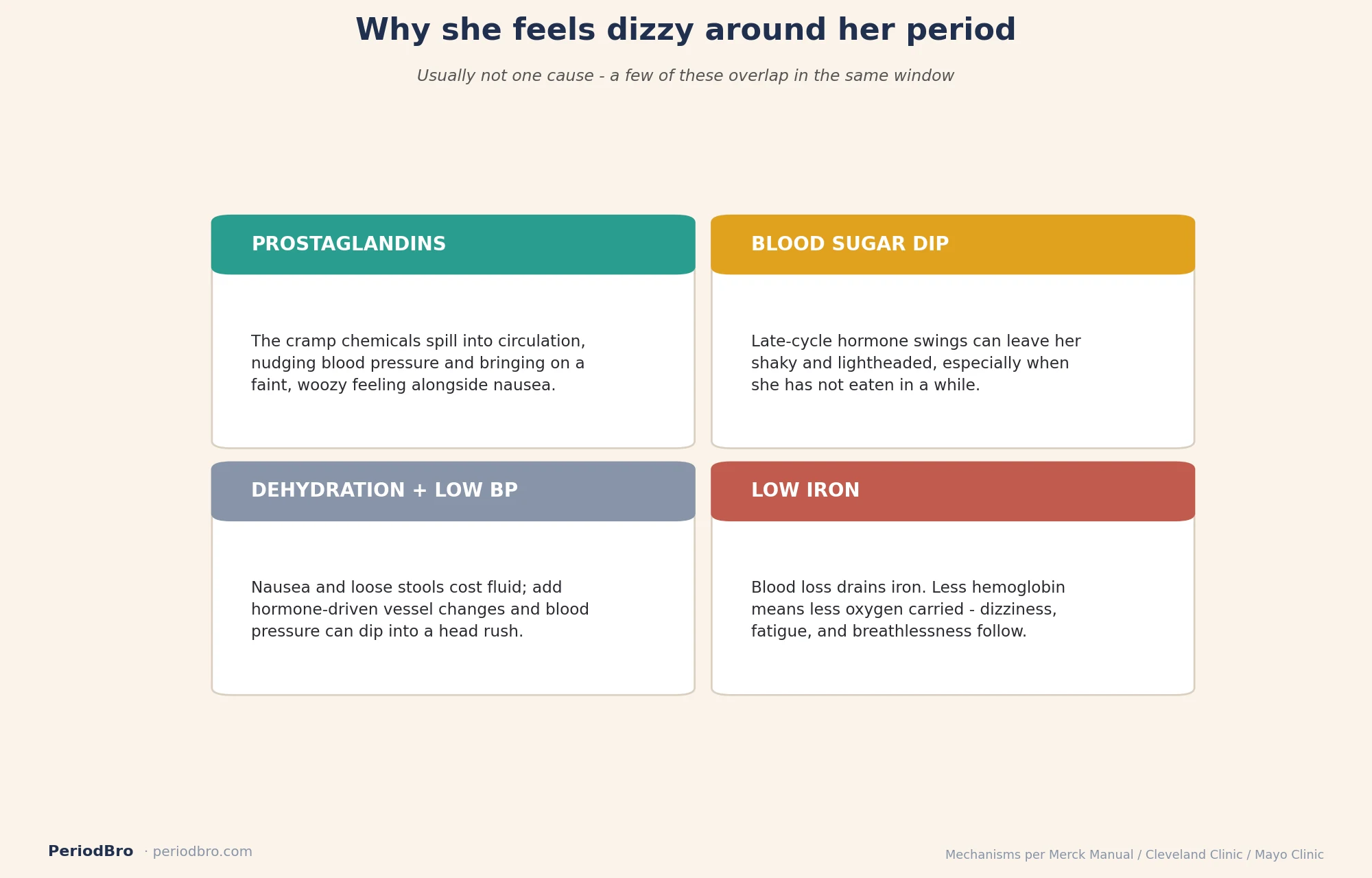
The first is prostaglandins. These are the same inflammatory compounds that drive period cramps by making the uterus contract. The problem is they don’t stay put. When the uterus pumps out a lot of them, some get absorbed into general circulation, and that systemic spillover can drive nausea, loose stools, and yes, that faint or lightheaded feeling. The Merck Manual notes that massive absorption of prostaglandins into the bloodstream can account for the cardiovascular and gut symptoms that ride along with painful periods (Merck Manual). If her cramps are bad, the dizziness often travels with them. This is the same machinery behind a lot of what I wrote about in the period cramps guide.
The second is a dip in blood sugar. The hormone swings in the late part of her cycle can change how her body handles insulin and blood sugar, and for some people that means a low that leaves them shaky and lightheaded, especially if they haven’t eaten in a while (Healthline). This is the most fixable one, and we’ll come back to it.
The third is dehydration and a small drop in blood pressure. Periods often come bundled with nausea, looser stools, or just not feeling like eating and drinking much. Lose a bit of fluid, add hormone-driven changes in how blood vessels behave, and her blood pressure can dip enough to make standing up feel like a head rush. If she’s also dealing with the queasy stomach I covered in the period nausea piece, the two feed each other.
The fourth, and the one worth taking most seriously, is low iron. Every period means losing blood, and blood loss means losing iron. When that’s heavy or happens month after month, iron stores drop, and the body can’t make enough hemoglobin to carry oxygen efficiently. Cleveland Clinic lists dizziness, fatigue, and shortness of breath among the core symptoms of iron-deficiency anemia (Cleveland Clinic), and Mayo Clinic explains the mechanism plainly: without enough iron, the body can’t produce enough hemoglobin, so it leaves you tired and short of breath (Mayo Clinic). If her dizziness shows up with heavy bleeding and exhaustion, iron is the first thing to think about.
One more honest note: if her dizziness comes with a pounding, one-sided headache and light sensitivity, that may be a menstrual migraine rather than the general wooziness here, and that has its own playbook in the menstrual migraines article.
How common this is, and why it’s not in her head
This is where it helps to drop the suspicion entirely. Systemic symptoms like nausea, fatigue, headache, and lightheadedness are described as fairly common companions to painful periods in the clinical literature (Merck Manual). And heavy bleeding, the thing that quietly drains iron, is far more common than most people realize. A European study of more than 4,000 otherwise healthy premenopausal women found symptomatic heavy menstrual bleeding in about 27% of them, and the majority of people with heavy bleeding turn out to be iron deficient (American Journal of Obstetrics & Gynecology).
So when she says the room went sideways for a second, believe her the first time. You don’t need to investigate it, rank it against your own worst headache, or reassure her that it’s “probably nothing.” Take it at face value, and quietly make the next hour easier. The useful instinct here is the same one that runs under everything in the luteal phase explainer: her experience is real even when you can’t see it, and your job is to lower the load, not to audit the symptom.

What actually helps when she feels lightheaded
You can’t reach in and rebalance her hormones. What you can do is remove the small things that make a dizzy spell worse and have the fixes ready before she has to ask.
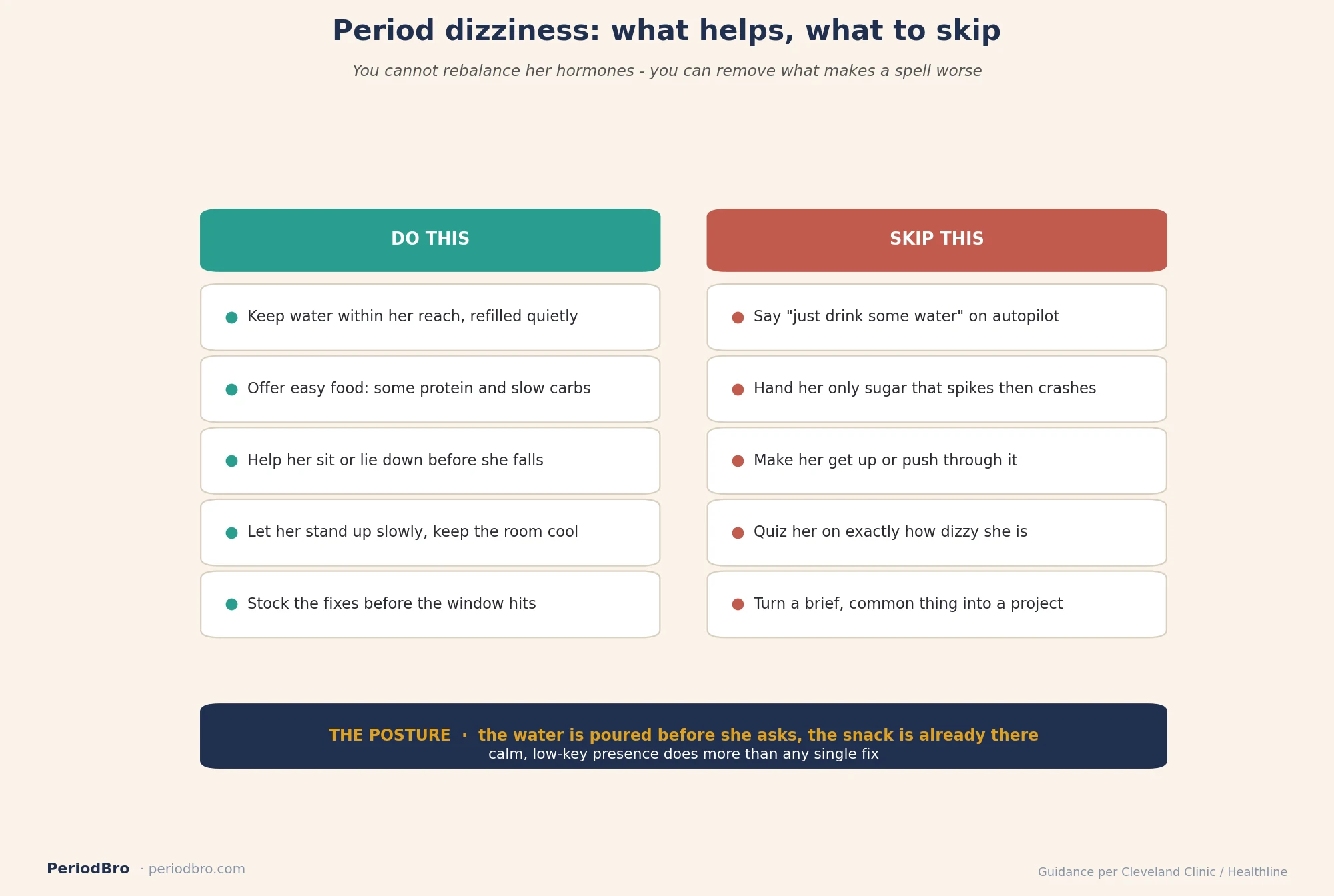
Start with water within reach. Dehydration is one of the most common amplifiers, so a full glass or bottle next to her, refilled without commentary, does more than it sounds like it should. Pair it with easy food that steadies blood sugar: something with a bit of protein and slow carbs, not just sugar that spikes and crashes. If you want a head start on stocking the right things, the pre-period food guide covers it. Over time, iron-rich foods matter too, but that’s a long game, not a same-day rescue.
When a spell actually hits, the move is simple: help her sit or lie down before she falls, not after. A head rush passes faster when she’s not fighting gravity. Don’t make her get up to do anything, and if she stands, let her do it slowly. Keep the room cool and let her rest without an audience. The worst thing you can do is turn it into a project, quiz her on exactly how dizzy she is, or imply she should push through it. The best thing is calm, low-key presence and the next useful object already in her hand.
When period dizziness is worth a doctor’s look
Most period dizziness is the ordinary kind: mild, brief, tracks her cycle, and eases off within a day or two of her period starting. But a few patterns are worth a conversation with her doctor, and as the partner, you’re often the one who notices the pattern she’s too in-it to see.

The big one is fainting or near-fainting. Actually passing out, or repeatedly feeling like she’s about to, is not something to wait out. The same goes for dizziness that comes with very heavy bleeding plus fatigue, breathlessness, a racing heart, or unusual paleness. That combination points toward significant anemia, which is treatable but should be checked. ACOG defines heavy menstrual bleeding as soaking through a pad or tampon every hour for several hours, bleeding longer than seven days, or passing large clots, and flags that it can lead to anemia (ACOG). If any of that sounds like her, a simple blood test can settle it.
Also worth flagging: dizziness that’s severe, that doesn’t track her cycle at all, that comes with chest pain or a true spinning-room vertigo, or that’s clearly getting worse month over month. None of this is meant to alarm you. It’s meant to give you the short list so you know the difference between “make her comfortable” and “let’s get this looked at.” When in doubt, the move isn’t to diagnose, it’s to gently support her in booking the appointment. This is also a good moment to make sure it isn’t the broader, flu-like crash I described in the period flu article, which can overlap.
The one thing to remember
If you take nothing else from this: when she goes quiet and reaches for the wall, you don’t need to understand the exact biochemistry in the moment. You need to get her sitting, get water and a snack into her hands, and keep your own energy calm. The understanding is what lets you do that without panic, and without making her manage your reaction on top of her own dizziness.
That’s really the whole thing. Learn the mechanism once, so that in the moment you can just be steady. The water was poured before she asked, the snack was already there, and she got to sit down and feel lousy for ten minutes without having to explain herself. That’s not a grand gesture. It’s just paying attention, which over a few years adds up to her never feeling alone in her own body around you.
This article is for general education and isn’t medical advice. Dizziness can have many causes beyond the menstrual cycle. If she faints, has very heavy bleeding with breathlessness or a racing heart, or her symptoms are severe or worsening, encourage her to see a healthcare professional.