Period Fatigue: Why She’s So Tired Before and During Her Period (and How to Help)
There’s a stretch most months where the person you love gets quiet, slow, and bone-tired for no reason either of you can point to. She slept eight hours and still can’t get off the couch. She cancels the thing she was looking forward to. And if you’ve ever thought “is she okay, or is she just done with me,” I want to save you the spiral: it’s usually neither. It’s period fatigue, and it has a mechanism you can actually understand.
I noticed the pattern in my own relationship before I had a word for it. Same few days each cycle, her battery just emptied. For a while I read it as a mood I’d caused, so I’d push to talk it out, which is the last thing a tired person wants. The thing that actually changed the week was small: I started watching the calendar instead of reading her face. Once the timing clicked, I stopped guessing and started helping, and the whole stretch got easier for both of us.
What period fatigue actually is
Fatigue isn’t a vague complaint here. It’s a recognized symptom of premenstrual syndrome, listed right alongside the bloating, irritability, and breast tenderness most people already associate with PMS (NCBI StatPearls, Premenstrual Syndrome). When clinicians map out what PMS does to the body, low energy is on the list, not in the margins.
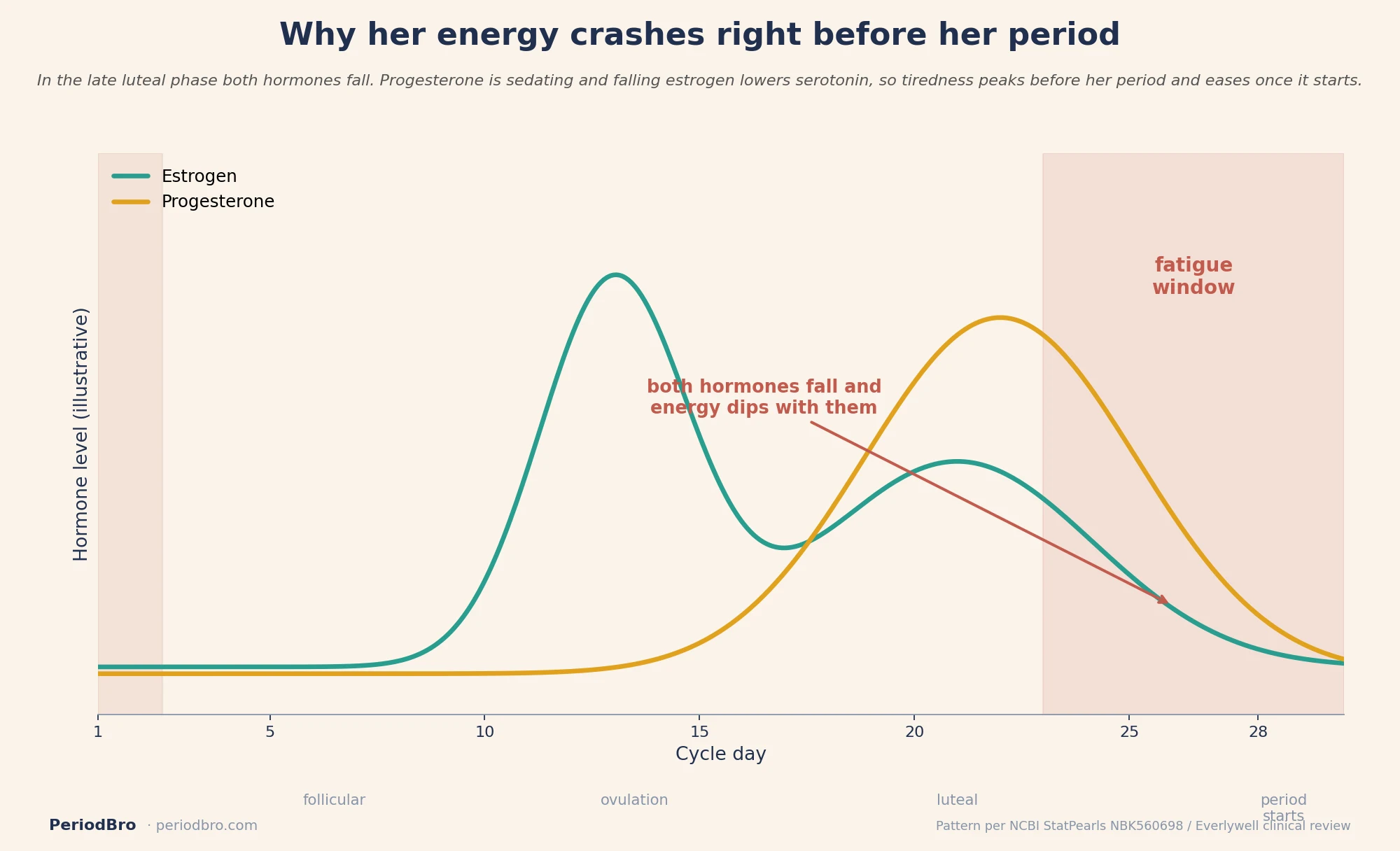
The timing is the tell. This kind of tiredness tends to peak in the late luteal phase, the five to seven days before her period starts, and often runs into the first day or two of bleeding. If you know roughly where she is in her cycle, you can usually see it coming before she says a word. (If the phases are still fuzzy for you, the luteal phase explainer is a quick way to get oriented.)

What’s happening in her body
A few things stack up at the same time, which is why the tiredness can feel heavier than a normal bad night’s sleep.
First, hormones. In the back half of her cycle, progesterone rises and then falls, and estrogen drops too. Progesterone has a natural sedating effect, so the days when it’s high can leave her genuinely drowsy (Everlywell, Why Am I So Tired on My Period). And when estrogen declines, levels of serotonin, a brain chemical tied to alertness and mood, tend to dip with it. So part of what looks like “no energy” is brain chemistry doing exactly what the cycle tells it to.
Second, iron. Menstrual bleeding means losing blood, and blood carries iron. For a lot of people that’s no big deal, but heavier periods can pull iron down far enough to cause fatigue, and in some cases iron-deficiency anemia, which the American College of Obstetricians and Gynecologists names directly as a consequence of heavy menstrual bleeding (ACOG, Heavy Menstrual Bleeding). Roughly 0.4 to 0.5 mg of iron leaves the body with every milliliter of blood lost, and research shows that even iron depletion that hasn’t yet become full anemia can cause tiredness and dull thinking (American Journal of Obstetrics & Gynecology). So “I’m exhausted” during a heavy period isn’t drama. It can be her body running low on a thing it needs to make energy.
Third, sleep. Cramps, restlessness, and mood shifts make it harder to fall asleep and stay asleep, so she can spend eight hours in bed and still wake up tired. Bad nights in the cycle compound the daytime drain. If you want the fuller picture on this, we went deep on how sleep changes through her cycle.
Put those three together, hormones pulling her down, iron possibly running low, sleep getting fragmented, and you get a tiredness that’s real, layered, and not about you.
Why this is so easy to misread
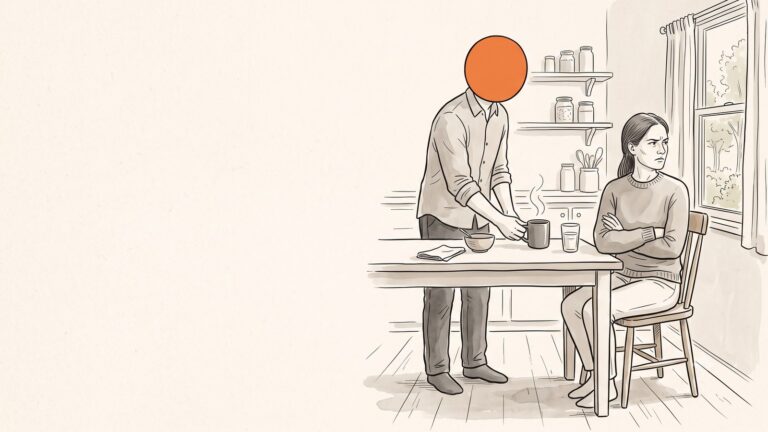
Here’s the trap a lot of well-meaning partners fall into. The fatigue shows up the same week her patience is thinner, so the low energy and the short fuse arrive together. It’s tempting to read both as “she’s pulling away from me” or “I did something.” Most of the time you didn’t. You’re watching a predictable monthly dip land on the same few days, and the calendar explains it better than any argument does.
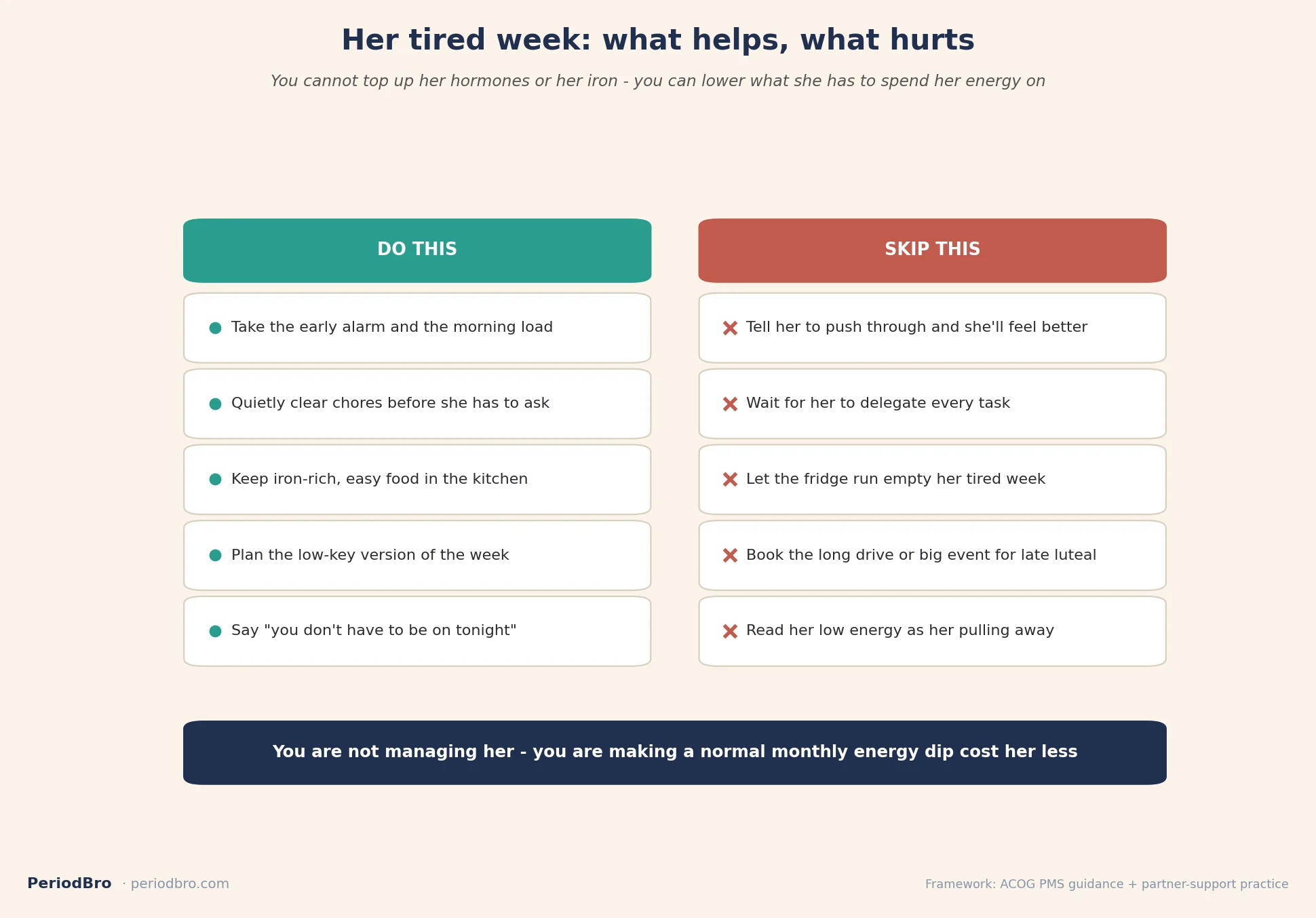
The other misread runs the opposite direction: treating it as something she should just push through. Telling a tired person to “just get up and you’ll feel better” is the kind of advice that sounds energizing and lands like a judgment. Her body is doing real work this week. The move isn’t to fix her energy. It’s to lower what she has to spend it on.
It also helps to remember this isn’t a forever state. The fatigue has a start and an end, and it tracks the cycle. By the time her period is underway and into the follicular phase that follows, the energy usually comes back on its own. You’re not managing a permanent problem. You’re covering a predictable few days, the way you’d want someone to cover for you if you were running a fever.

How to actually help with period fatigue
You can’t top up her hormones or hand her iron back. What you can do is take weight off the week, and that’s worth more than it sounds.
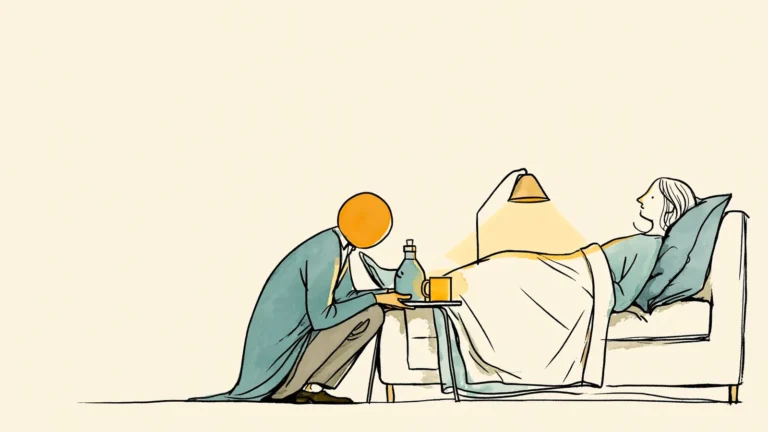
Protect her sleep first. If cramps are what’s keeping her up, an over-the-counter anti-inflammatory like ibuprofen taken before bed can ease the pain enough to let her actually rest, which is a standard, low-drama approach (Medical News Today, Period Fatigue). We broke down the specifics in what actually works for period cramps. Take the early alarm yourself. Handle the thing that would otherwise drag her out of bed at 7 a.m.
Lower the load. This is the whole game. Quietly take items off the shared list before she has to ask, cook the dinner, run the errand, manage the logistics that week. Don’t make her delegate, just do it. The energy she isn’t spending on the dishes is energy she gets to keep.
Feed the tank. Iron-rich and complex-carbohydrate foods support steadier energy across the cycle, so having the right stuff in the kitchen actually matters here. If you want a ready-made list, what to keep at home before her period covers it.
Don’t schedule the hard stuff for late luteal. If you’ve got any say over the calendar, keep the big social commitments, the long drives, the demanding visits off the days you know tend to flatten her. Plan the low-key version instead. Nobody regrets a quiet night when the alternative was running on empty.
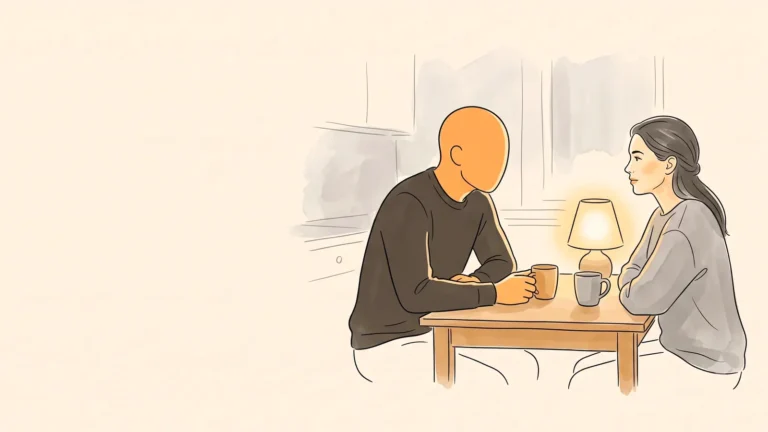
And say the thing that takes the pressure off: “You don’t have to be on tonight. I’ve got it.” Permission to be tired is its own kind of relief.
When period fatigue is worth a doctor’s look
Most cyclical tiredness is just part of the range, annoying and temporary. A few patterns are worth flagging, and you can be the one who gently raises them.
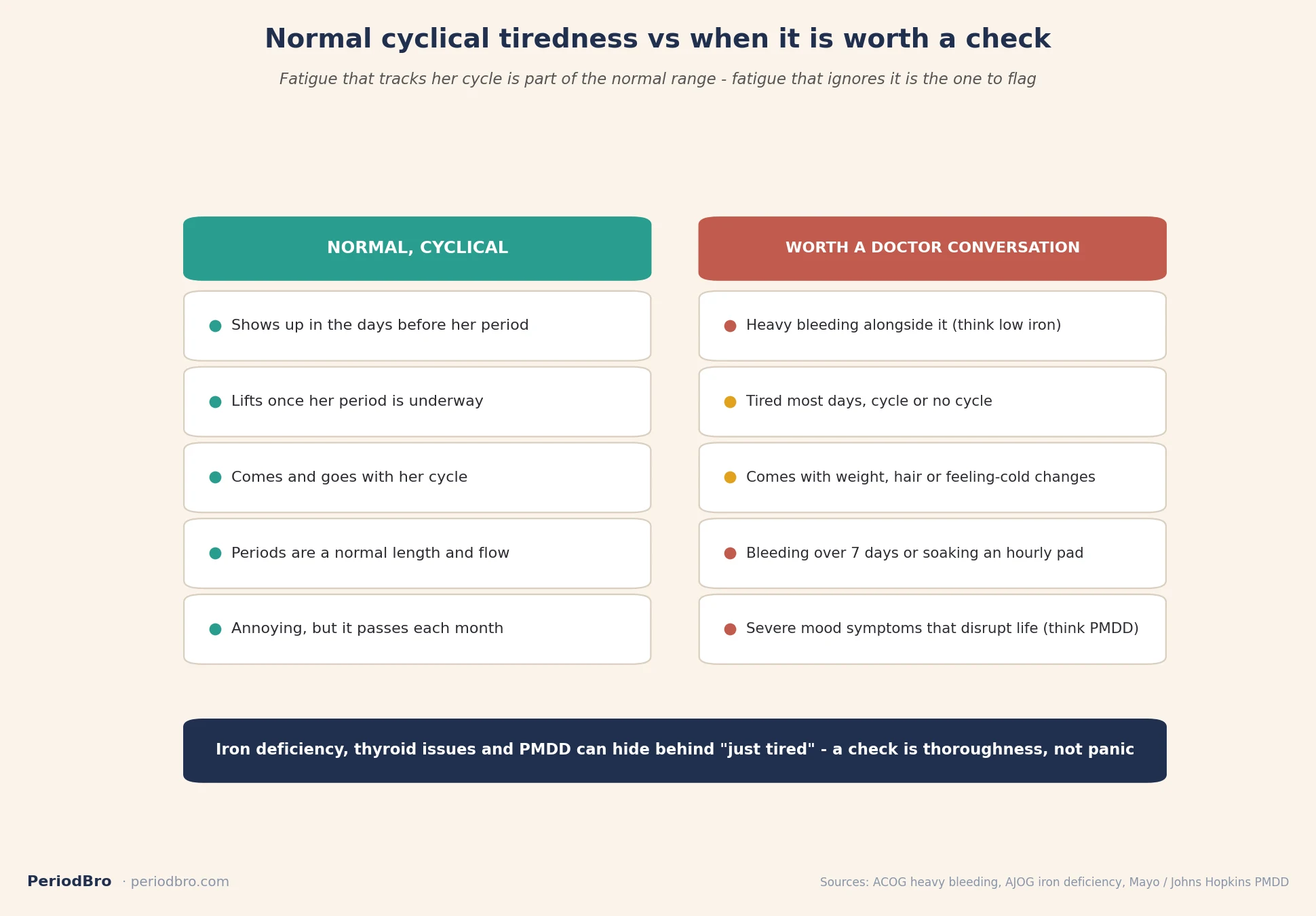
If her periods are heavy, fatigue plus heavy bleeding is the combination most likely to point at low iron or anemia. ACOG considers bleeding heavy when it lasts more than seven days, soaks through a pad or tampon every hour for several hours in a row, requires doubling up on protection, forces changes during the night, or passes clots the size of a quarter or larger (ACOG, Heavy Menstrual Bleeding). Any of those plus constant exhaustion is a “let’s get your iron checked” conversation, not something to wait out.
If the tiredness doesn’t track her cycle, that’s a different signal. Fatigue that hangs around all month, or comes with weight changes, hair changes, or feeling cold, can point to a thyroid issue rather than a hormonal one. Subclinical hypothyroidism shares a lot of symptoms with PMS, which is exactly why doctors look at the thyroid before settling on a premenstrual explanation (Mayo Clinic Press).
And if the fatigue comes bundled with severe mood symptoms that genuinely disrupt her life every cycle, that can be premenstrual dysphoric disorder, a more intense condition than ordinary PMS, with fatigue and low energy among its recognized symptoms (Johns Hopkins Medicine). The good news is PMDD is treatable. We laid out how to tell it apart from regular PMS in PMS vs PMDD. Pushing for a check here isn’t alarmist. It’s being thorough on her behalf.
The one thing to do this month
Pick the few days before her period and decide, in advance, that those are low-demand days in your house. Don’t announce it like a policy. Just quietly take more of the load, protect her sleep, keep the calendar gentle, and let her be tired without it costing her anything. That’s the whole skill: not fixing her energy, just making sure a normal monthly dip lands softer.
Knowing roughly when those days are coming is most of the battle, and it’s the reason a lot of partners start tracking in the first place. PeriodBro turns her cycle into a simple heads-up, so the tired week stops catching you off guard and starts being a week you’re ready for.
This article is for general information and isn’t medical advice. Fatigue has many causes, and persistent or severe tiredness, heavy bleeding, or symptoms that disrupt daily life are worth a conversation with a doctor.