
Is Her Period Pain Normal? When It’s More Than Just Cramps
Someone I dated kept a heating pad in her desk drawer at work. I remember thinking that was impressively organized. Then one evening she mentioned a friend who’d just been diagnosed with endometriosis after eight years of being told her pain was normal, and I finally did the math on that drawer. When pain is predictable enough, and bad enough, that it needs its own equipment at work, that’s information worth acting on.
So let’s answer the question properly: is her period pain normal? Most of the time, yes. Period cramps are one of the most common experiences on the planet. But there’s a line where normal ends and “this needs a doctor” begins, and almost nobody teaches partners where that line sits. Her doctor might not even ask. You, the person who sees her every month, are weirdly well positioned to notice when something’s off.
This isn’t about diagnosing anyone from your couch. It’s about knowing enough to take the right things seriously.
Is her period pain normal? The honest baseline
The medical term for period pain is dysmenorrhea, and it comes in two types. Primary dysmenorrhea is the standard-issue version: cramps caused by prostaglandins, hormone-like chemicals that make the uterus contract to shed its lining. More prostaglandins, stronger contractions, more pain. According to the Cleveland Clinic, this kind of cramping usually starts a day or so before bleeding, peaks in the first day or two, and fades as the period goes on.
Primary dysmenorrhea is real pain. It’s not imaginary and it’s not weakness. But it has a recognizable shape: it responds to ibuprofen or naproxen, it responds to heat, and it doesn’t usually wreck her entire week. If that’s her experience, what helps most is practical support, and we’ve covered that playbook in detail in what actually works for period cramps.
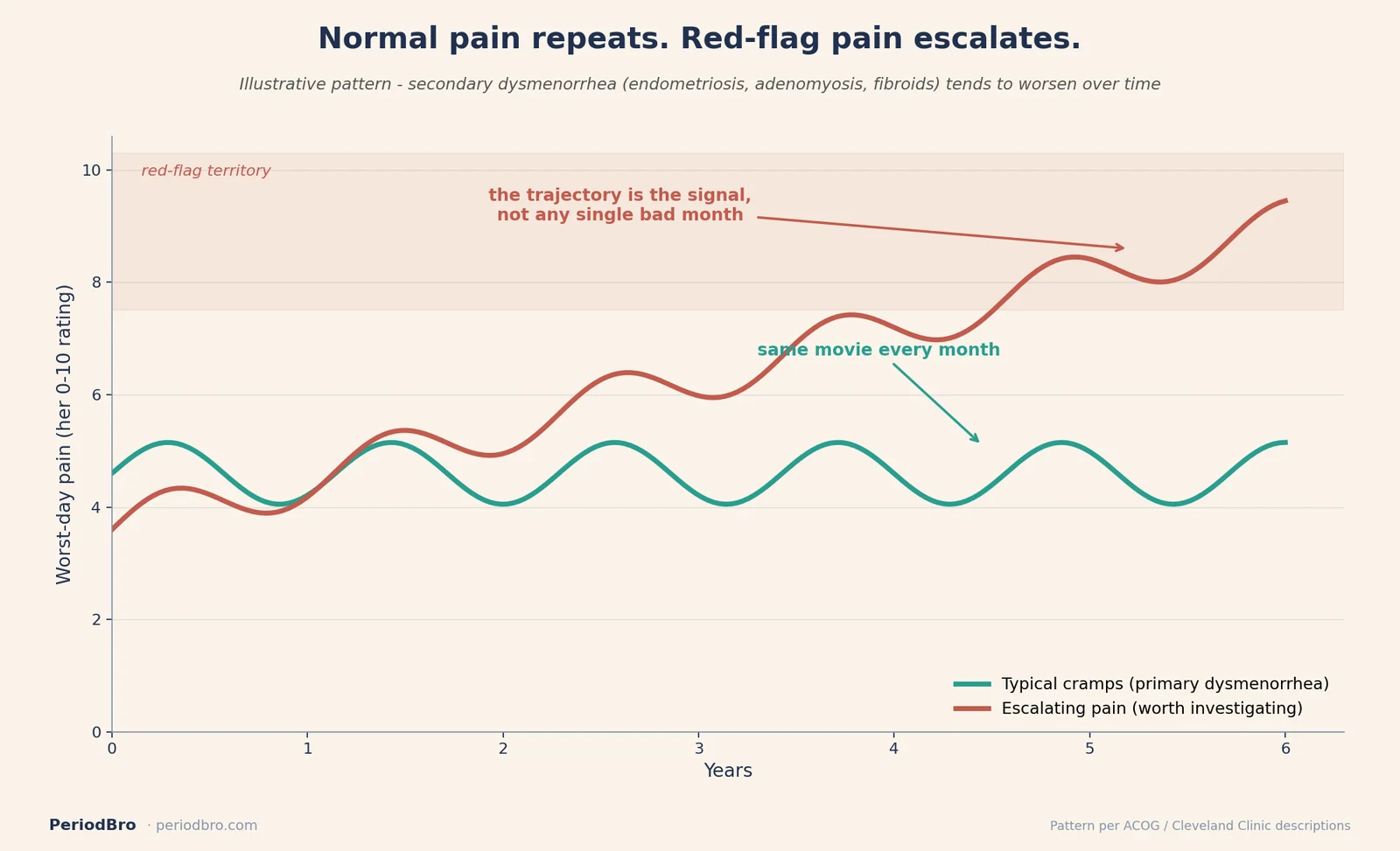
Secondary dysmenorrhea is different. That’s pain caused by an underlying condition, most often endometriosis, adenomyosis, or fibroids. Per ACOG, the American College of Obstetricians and Gynecologists, secondary dysmenorrhea tends to show up later in life, get worse over time, and last longer than typical cramps. That trajectory matters. Normal cramps are roughly the same movie every month. Pain that keeps escalating year over year is a different film.
The line between rough and red flag
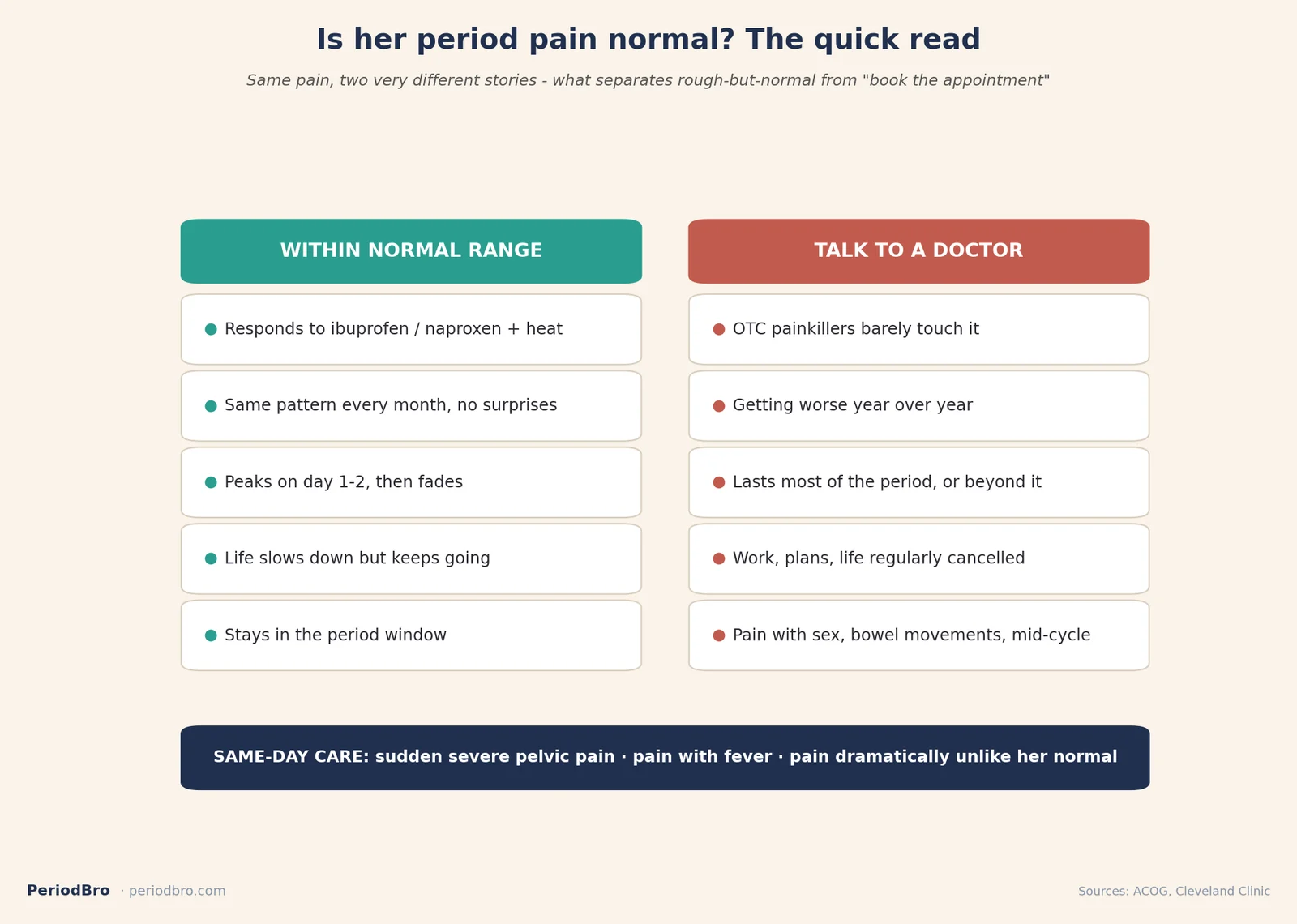
Here’s the shorthand version. Period pain is probably in the normal range when it shows up around day one, responds to over-the-counter painkillers and heat, and lets her get on with life, even if life is slower and grumpier than usual.
It deserves a doctor’s appointment when any of these are true:
- Painkillers don’t touch it. Research published in a review of NSAID resistance in dysmenorrhea found that about 18 percent of women get minimal or no relief from NSAIDs like ibuprofen. That’s not a character flaw or a low pain threshold. In the same body of research, around a quarter of women with NSAID-resistant period pain had imaging findings suggestive of endometriosis.
- Life stops. Missing work, cancelling everything, being unable to stand upright. The same review notes period pain still causes 10 to 20 percent of US female high school students to miss class. Common, yes. “Fine,” no. Pain that regularly takes someone out of their own life warrants investigation.
- The pain has spread beyond the period. Pelvic pain mid-cycle, pain during sex, pain with bowel movements or urination, especially during her period. These patterns point away from garden-variety cramps.
- The bleeding is heavy. ACOG’s definition is concrete: soaking through a pad or tampon every hour for several hours in a row, bleeding longer than seven days, or clots the size of a quarter or bigger. If she’s setting alarms to change protection overnight, that’s worth a conversation with a doctor.
- It’s getting worse every year. Escalation is the signature of secondary dysmenorrhea.
One more for the urgent column: sudden severe pelvic pain, pain with fever, or pain that feels dramatically different from her normal is a same-day medical situation, not a wait-and-see one.
A quick disambiguation, because the symptoms overlap: feeling achy, exhausted, and generally unwell in the days before the period is its own (usually benign) phenomenon, which we’ve unpacked in what period flu is and how to help. The red flags above are about pain, its intensity, and its trajectory. Different question, different checklist.
Notice what’s on neither list: how well she hides it. Plenty of people run on stage-grade composure through pain that would flatten the rest of us, because they’ve had years of practice and not much choice. So if you’re asking yourself whether her period pain is normal based on how functional she looks, you’re reading the wrong gauge. Ask about the pain itself.
What might be behind pain that isn’t normal
The most common culprit is endometriosis, a condition where tissue similar to the uterine lining grows outside the uterus, where it has no business being. The World Health Organization estimates it affects roughly 10 percent of reproductive-age women and girls worldwide. That’s about 190 million people. Statistically, you already know several of them.
And here’s the part that should bother you: it routinely takes years to diagnose. Studies of diagnostic delay report averages ranging from about four years in the best recent data to a decade or more in some countries. Years of someone reporting serious pain and hearing some version of “periods hurt, that’s life.” The pain gets normalized by everyone around her, and often, eventually, by her.
Adenomyosis (similar tissue growing into the muscle wall of the uterus) and fibroids (benign growths in the uterus) round out the usual suspects. All three are treatable. None of them can be treated while everyone’s still calling them “bad cramps.”
This is why the question “is her period pain normal” is worth asking out loud instead of assuming. The default answer, the one her friends, her family, and sometimes her doctors have been giving her since she was a teenager, is “yes, periods just hurt.” For nine out of ten women that’s roughly true. For the tenth, that default answer is the reason her diagnosis takes years.

Where a partner actually fits in
You can’t diagnose her and you shouldn’t try. But there are four things a partner can do that genuinely move the needle.
Believe the pain at face value
The single most damaging thing in the endometriosis story is the gap between when pain starts and when it’s taken seriously. Don’t add to that gap at home. If she says it’s a nine out of ten, it’s a nine out of ten. You don’t need to verify it, rate it against your own experiences, or check whether she “seems” like a nine. We’ve written about being supportive when you can’t fix her pain, and the first step is always the same: presence without skepticism.
Help build the record
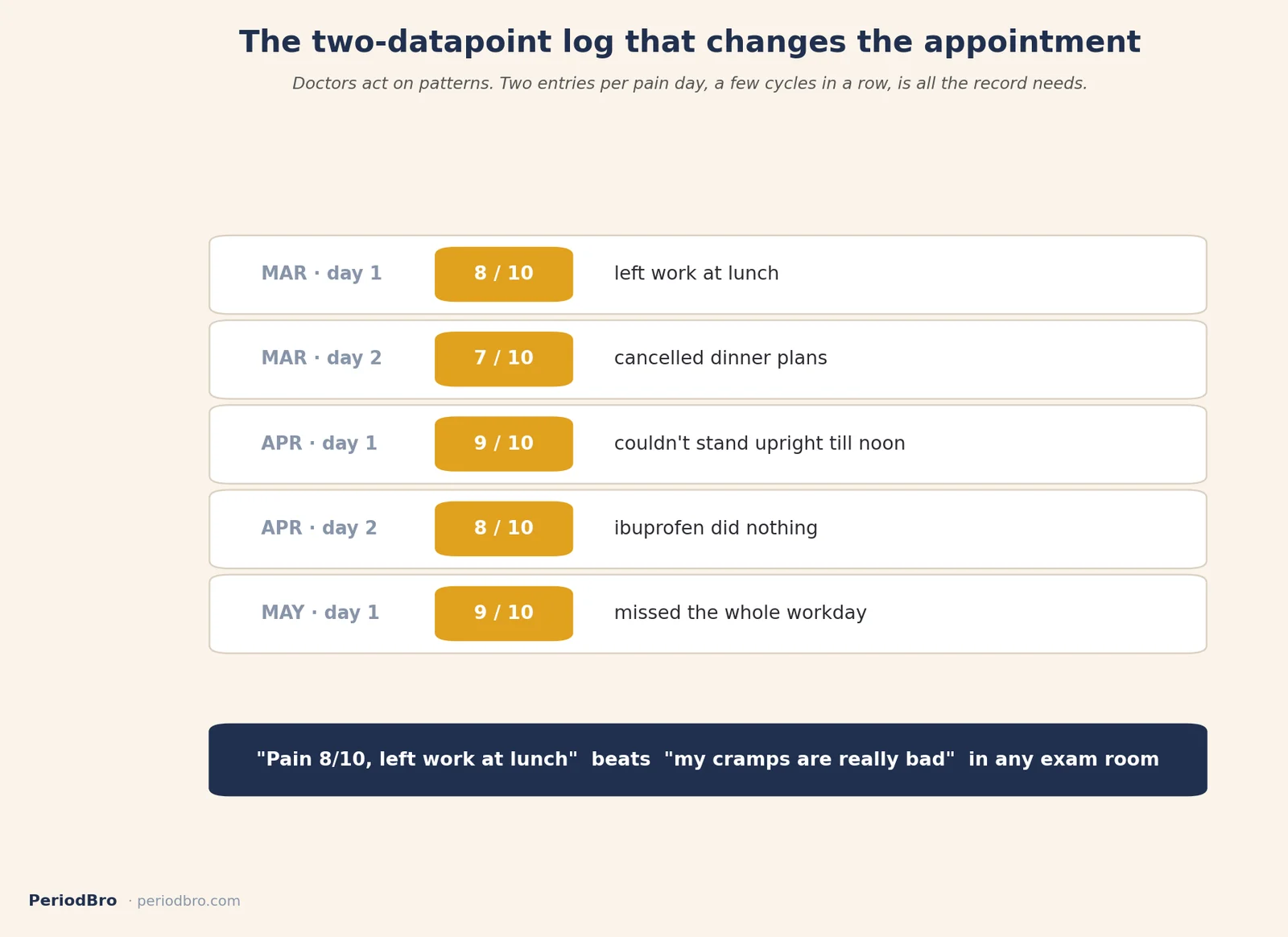
Doctors act on patterns, not vibes. A symptom log changes the conversation in an exam room. Two data points per pain day are enough: how bad it was, and what it stopped her doing. “Pain 8/10, left work at lunch” beats “my cramps are really bad” in any consultation. If she’s open to it, tracking this together over a few cycles builds exactly the record a gynecologist needs, and it signals that you consider her pain a real, documentable thing rather than monthly background noise.
Support the appointment, don’t run it
If she decides to see a doctor, your job is logistics and backup: handle the calendar, drive, sit in the waiting room if she wants company. Some people want a second set of ears in the appointment; some emphatically don’t. Ask which one she wants. Her health, her lead.
Keep the home playbook running
Whatever the medical answer turns out to be, the monthly support basics still matter: heat, the right painkillers taken early rather than heroically late, food that doesn’t require her to do anything. We’ve covered the full pain relief buyer’s guide if you want to stock the shelf properly.
The one thing to do this week
Pick a quiet, non-period moment and ask one question: “On the worst day of your cycle, how bad does it actually get?” Then just listen. You’re not solving anything. You’re collecting the baseline, and you might be the first person in years who asked her that question without already having an answer ready.
If what you hear includes painkillers that don’t work, plans cancelled every month, or pain that’s growing year over year, gently put a doctor’s visit on the table and offer to help make it happen. That conversation has shortened more diagnostic odysseys than any app ever will.
But an app helps with the record. PeriodBro lets you track her cycle, log the hard days, and show up prepared, with her knowledge and her consent, always. The free trial takes about a minute to set up.
This article is for general information and isn’t medical advice. For diagnosis and treatment of period pain, see a qualified clinician.