How to Help Girlfriend with Period Cramps: What Actually Works (Men’s Guide)
If you’re trying to figure out how to help girlfriend period cramps stop hurting — without making it weird, without giving her the wrong drug, without hovering — this is the article I wish I’d had. The first time my partner had bad cramps in front of me, I gave her Tylenol. It worked about as well as a mint.
It wasn’t until later — much later — that I learned period cramps and headaches are different problems. Different mechanism, different chemistry, different drug. Nobody told me. The pharmacy aisle doesn’t tell you. The Advil box doesn’t tell you. You figure it out by accident, or by having a partner who’s tired enough to spell it out.
So here’s the article I wish I’d had. What’s actually proven to help, what you can have ready before she even asks, and what’s worth ignoring no matter how often you’ve heard it.
How to Help Girlfriend Period Cramps: The 30-Second Version
If she’s curled up right now and you’re reading this on your phone, here’s the action list:
- Ibuprofen (Advil, Motrin) — not Tylenol. Cramps are inflammatory. NSAIDs target the cause. Acetaminophen doesn’t.
- A heating pad on the lower abdomen. Cheap, effective, and there’s real research behind it.
- Water and something to eat. Cramps + low blood sugar + dehydration = worse cramps.
- Don’t push her to move. Exercise helps over the long run, not when she’s mid-cramp.
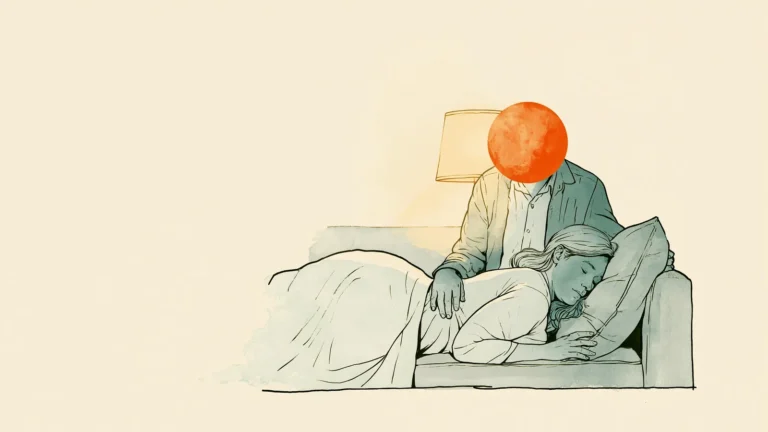
- Stay nearby without hovering. “Anything you need?” once, then read in the other room.
That’s most of it. The longer version explains why and what else.
What Cramps Actually Are
Period cramps — the medical name is dysmenorrhea — are caused by chemicals called prostaglandins. During menstruation, the uterus releases prostaglandins to make its muscle wall contract and shed the lining. Those contractions are what she feels. More prostaglandins, stronger contractions, more pain. Per ACOG’s guidance on dysmenorrhea, the pain typically starts shortly before bleeding begins and peaks in the first day or two.
This matters because almost every relief strategy that actually works does one of two things: it either blocks prostaglandins or relaxes uterine muscle. Things that do neither — Tylenol, chocolate, “just rest” — don’t address the cause. They might feel like care. They don’t lower the pain.
The Things That Actually Work
1. Ibuprofen or naproxen — not acetaminophen
This is the single most useful fact in this article. Ibuprofen (Advil, Motrin) and naproxen (Aleve) are NSAIDs — non-steroidal anti-inflammatory drugs. They block prostaglandin production. That’s why they work on cramps.
Acetaminophen (Tylenol, Panadol) works on a different pain pathway and is consistently less effective for menstrual pain. The Cochrane systematic review on NSAIDs for dysmenorrhea — which pooled data from 80+ trials — found NSAIDs significantly more effective than placebo, and more effective than acetaminophen, for menstrual pain.
Dosage: standard adult ibuprofen dose. If she’s been doing this for years she probably knows her dose; if she’s not sure, the label has it. The trick is to take it at the first sign of cramps, not after they’re already bad. Prostaglandins compound — heading them off early is much more effective than chasing them.
2. Heat — heating pad, hot water bottle, warm bath
This isn’t grandma advice. Heat on the lower abdomen is supported by clinical trials. A widely cited RCT by Akin et al. found continuous low-level heat therapy was as effective as ibuprofen for menstrual pain. The Cochrane review on topical heat for dysmenorrhea found moderate evidence of effectiveness, especially in combination with ibuprofen.
Practical: keep a heating pad in the bathroom drawer year-round. The cheap microwaveable kind works fine. A hot water bottle works fine. A warm bath works fine. Stack heat on top of ibuprofen — together they out-perform either alone.
3. Hydration and food
This is the soft-evidence corner. Cramps don’t have a strong proven link to hydration or specific foods, but pain perception worsens when you’re dehydrated or hungry. A glass of water and a small snack costs nothing and removes confounding variables. Don’t make this a project. Bring it to her without commentary.
4. Movement — but later
The Cochrane review on exercise for dysmenorrhea (Armour et al., 2019) found that regular exercise — three or four sessions per week of moderate-intensity activity — meaningfully reduces menstrual pain intensity. The keyword is regular. Suggesting she go for a walk while she’s actively cramping is unhelpful. Suggesting she keep up her usual yoga or running routine through the month is supported by evidence.
Your job during a cramp episode: don’t push movement. Your job between episodes: if she’s the kind of partner who already exercises, support that — it pays off the next month.
5. TENS — if cramps are a recurring thing
A TENS unit (transcutaneous electrical nerve stimulation) is a small device that sends mild electrical pulses through skin pads. Cochrane reviews show moderate evidence that high-frequency TENS reduces menstrual pain. They cost around $30 on Amazon. If she has cramps bad enough that this article was searched on her behalf, a TENS unit is a reasonable thing to put in the bathroom alongside the heating pad.
Things People Swear By — But the Evidence Is Thin
You’ll see these recommended everywhere when you search for how to help girlfriend period cramps. Some of them might work for some people. None of them have the kind of evidence base ibuprofen and heat do.
- Chocolate. Comforting. Not a treatment. The dark-chocolate-magnesium story is a stretch from limited data.
- Magnesium supplements. Some small studies suggest a benefit, others find none. Not first-line.
- Herbal teas (chamomile, ginger, fennel). Limited evidence. Won’t hurt, won’t dramatically help.
- Avoiding dairy / “anti-inflammatory diet.” Long-term diet pattern may matter; making her drink almond milk during an episode does nothing.
- CBD. Trending, evidence weak so far.
If she likes any of these and they’re part of her routine, great. Don’t substitute them for ibuprofen and heat.

When It’s More Than Cramps
This is the section worth reading even if everything else in the article is review.
“Normal” cramps respond to NSAIDs and heat, last one to three days, and don’t keep her in bed missing work or school. Per ACOG’s guidance, pain that doesn’t fit that pattern deserves a doctor visit. Specifically:
- Pain that doesn’t respond to over-the-counter NSAIDs when taken correctly and on time.
- Pain that causes her to miss work, school, or normal life repeatedly.
- Pain that’s getting worse over time — cycle after cycle, more intense.
- Pain outside of her period — mid-cycle, after sex, with bowel movements.
- Bleeding that soaks through a pad or tampon every hour for multiple hours.
Any of those can be signs of endometriosis, fibroids, adenomyosis, or another condition that needs evaluation. Endometriosis specifically is underdiagnosed — the average diagnostic delay is years. If she has been writing off the same severe pain every month for a long time, the most useful thing you can do is gently suggest an OB-GYN visit. Don’t diagnose. Just remove the resistance to going.
How to Help Girlfriend Period Cramps — The No-Skill Version
If you remember nothing else from this article, here’s how to help girlfriend period cramps without overthinking it:
- Know roughly when her period is due. Three days before, restock ibuprofen and check that the heating pad is in the drawer. If you want to be the partner she remembers, this is the move — tracking her cycle without being creepy is a separate piece, but the short version: knowing the date is enough.
- When cramps start, bring her ibuprofen and water without commentary. Don’t say “I think you should…” Just bring it.
- Plug in the heating pad. Hand it to her. Don’t ask. Don’t explain. Don’t make a production of it.
- Read in the room next door. Available, not in the way. The opposite of vanishing, the opposite of hovering.
- Don’t reschedule the rest of her life around it. Cramps are a real reason to slow down, not a reason to treat her like an invalid.
That’s it. Most of the work is in steps one and two — pre-stocking and not making it weird.
If you want the wider context on when cramps tend to be worst and why, here’s a deeper read on the luteal phase and the days leading into her period, and the broader support playbook.
FAQ
Should I give her ibuprofen or Tylenol for cramps?
Ibuprofen (Advil, Motrin) or naproxen (Aleve). These are NSAIDs and block the prostaglandins that cause cramps. Tylenol (acetaminophen) works on a different pain pathway and is consistently less effective for menstrual pain, per the Cochrane review on NSAIDs for dysmenorrhea.
Does a heating pad actually work or is it just comfort?
It actually works. An RCT by Akin et al. found low-level heat as effective as ibuprofen for menstrual pain. Stack heat on top of ibuprofen for best results.
How early should she take ibuprofen?
At the first sign of cramps, not when they’re already bad. Prostaglandins compound through the day. Taking ibuprofen early heads them off; taking it late means chasing pain that’s already escalating.
When should we see a doctor about her cramps?
If pain doesn’t respond to OTC NSAIDs, causes her to miss work or school repeatedly, gets worse over time, or occurs outside her period — those are all flags for conditions like endometriosis or fibroids that need evaluation. The average diagnostic delay for endometriosis is years; pushing for a doctor visit earlier is a real act of care.
One Last Thing
The reason most guys feel useless when their partner has bad cramps is that nobody ever explained the chemistry. Once you know prostaglandins drive contractions, NSAIDs block prostaglandins, heat relaxes the muscle, and exercise builds tolerance — the whole problem becomes a checklist you can run before she even asks.
PeriodBro tells you when her cramp window is approaching, so you can stock ibuprofen and the heating pad three days ahead and not be the guy frantically opening cabinets at 11pm. Start with PeriodBro →
PeriodBro provides educational information and is not a substitute for professional medical advice. If period pain is severe, getting worse, or interfering with her life, consult an OB-GYN.