PCOS in Teenage Girls: A Dad’s Guide to Signs, Diagnosis and Support
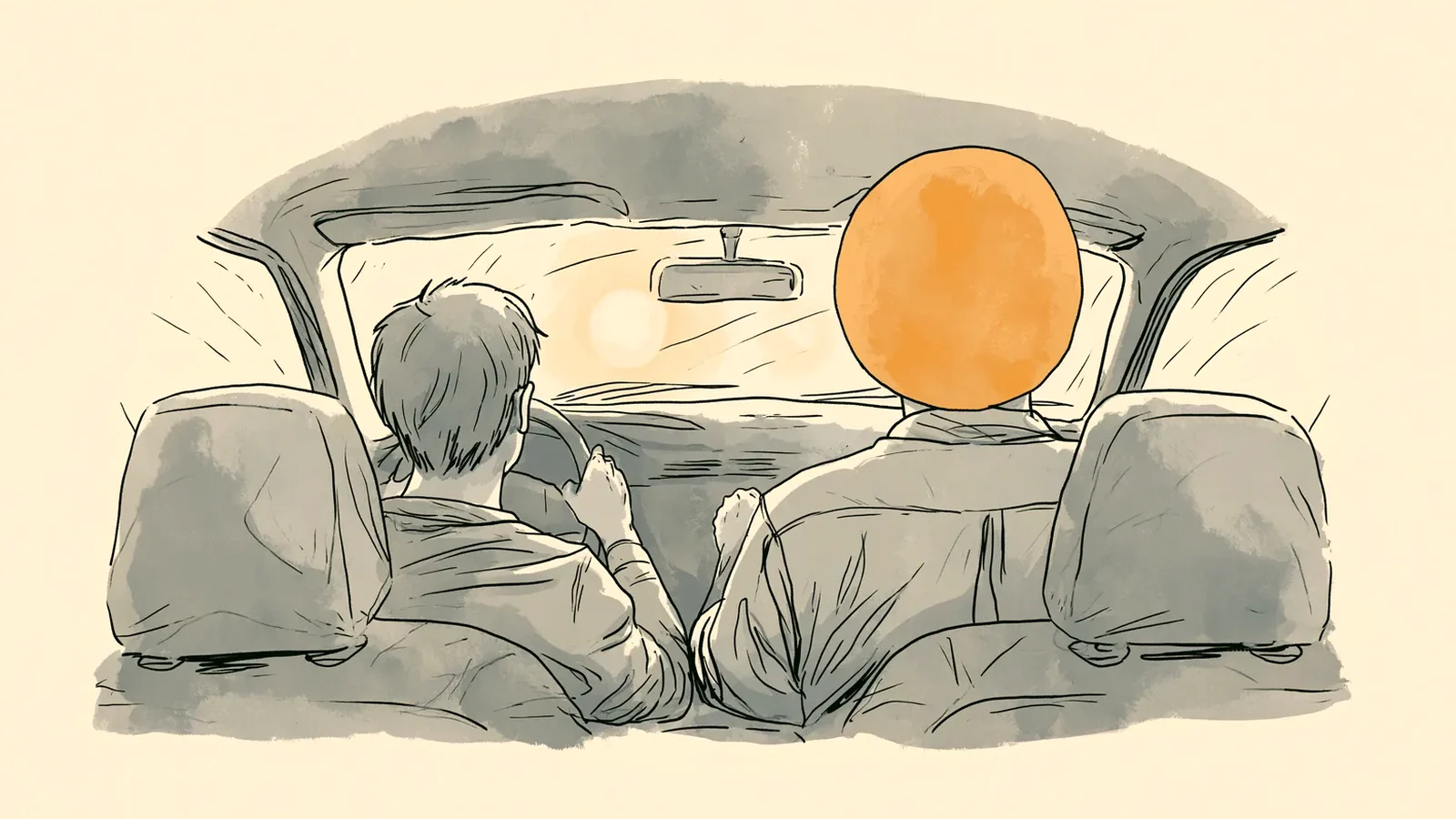
A dad I know noticed dark hair on his 15-year-old’s chin and, trying to be light about it, joked that she was catching up to him. She went quiet, then stopped eating dinner with the family for two weeks. Months later a doctor told them it was probably PCOS, and the joke was the part she still remembered best. If you’re reading about PCOS in teenage girls, you’re probably in the early stage of wondering, and that’s the best time to learn how this works.
Below: how doctors tell PCOS from normal early cycles, what the diagnosis involves, how to handle acne, hair and weight without commenting on her body, and what to ask at the appointment.
PCOS stands for polycystic ovary syndrome, a hormone condition where the body makes more androgens (hormones like testosterone) than usual and ovulation becomes irregular. Boston Children’s Hospital’s Center for Young Women’s Health says 5 to 10% of young females have it (Center for Young Women’s Health). The WHO estimates 10 to 13% of women of reproductive age have PCOS, with up to 70% of them undiagnosed (WHO). With that many cases undiagnosed, a teenager’s questions deserve a real answer. Our adult-focused guide to PCOS and periods covers the condition in general. This one is about the teen years, where the rules are different.
Why PCOS in teenage girls is hard to spot
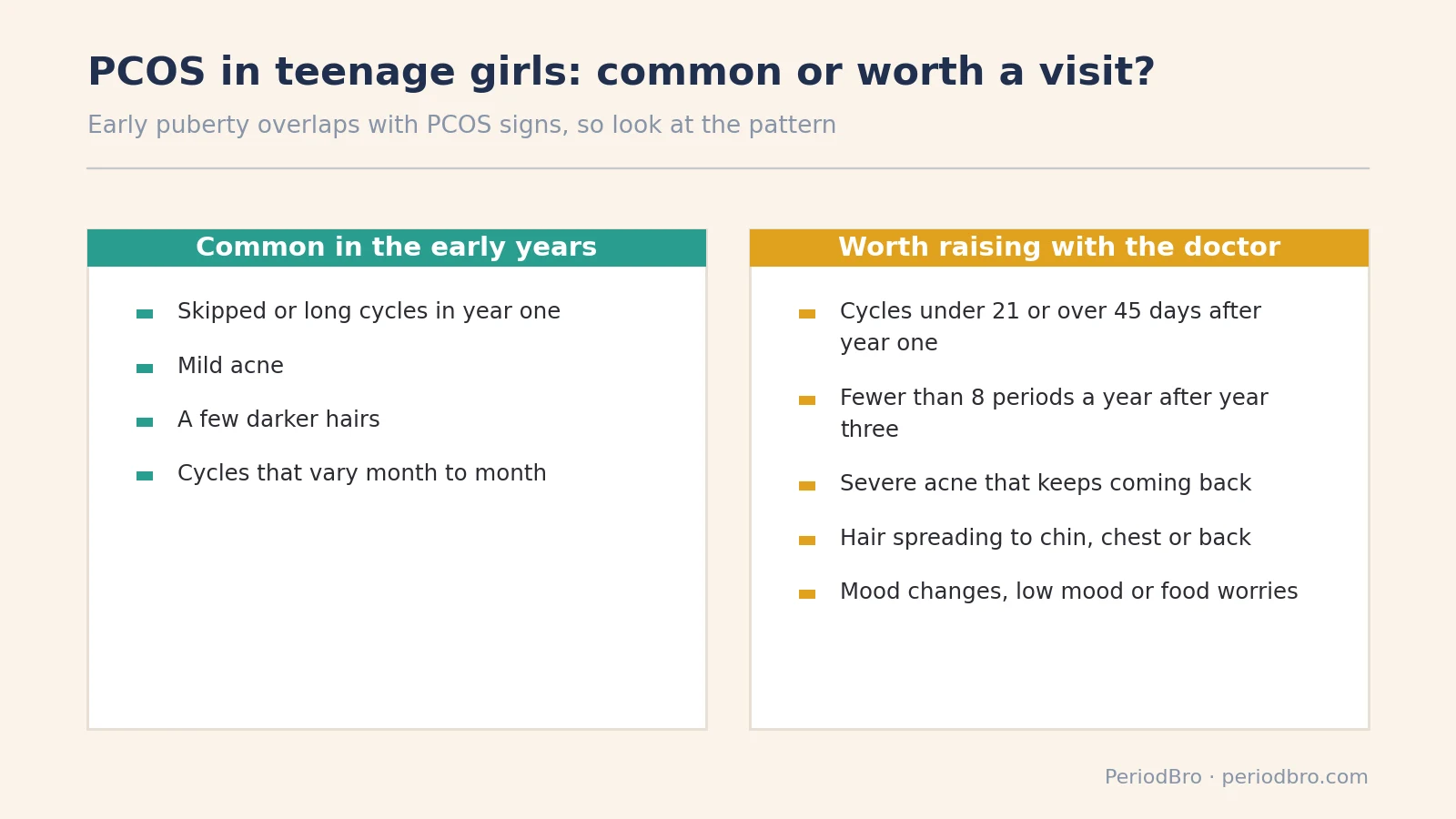
The early years after a first period are messy for almost everyone. Her hormone system is still learning to run a regular cycle, so skipped months, long gaps and short cycles are normal. ACOG’s committee opinion on using the cycle as a vital sign notes that about 90% of adolescent cycles fall between 21 and 45 days, even when they look irregular (ACOG Committee Opinion 651). Mild acne is common too. Because the textbook signs of PCOS overlap with ordinary puberty, doctors worry about over-diagnosing girls as much as missing them.
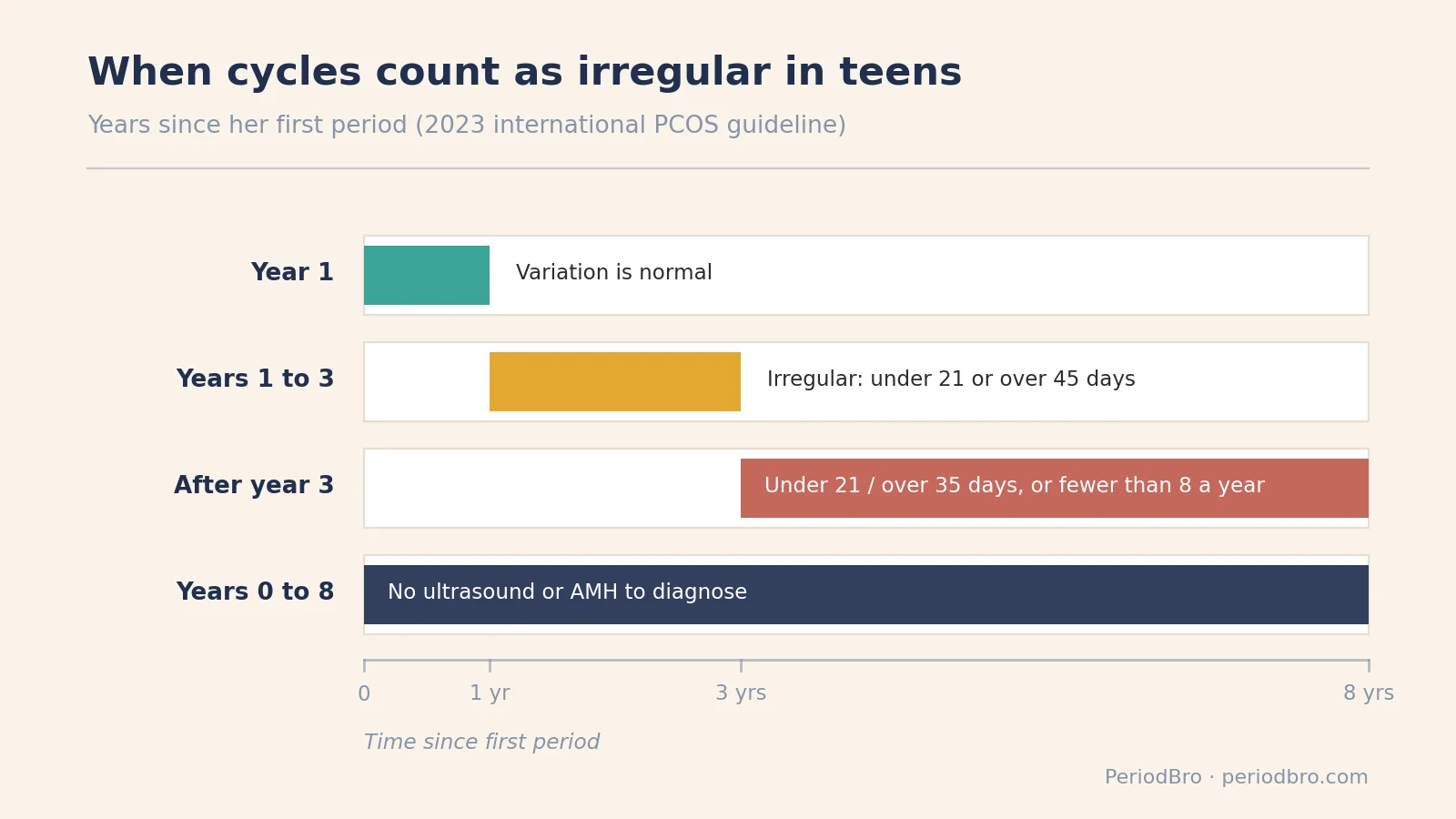
That’s why the 2023 international PCOS guideline sets stricter rules for the eight years after a first period. As summarized in a 2025 review, irregular cycles are judged by time since her first period (Geburtshilfe und Frauenheilkunde, 2025):
- In the first year, variation is expected and counts as normal.
- From one to three years, a cycle shorter than 21 or longer than 45 days counts as irregular.
- After three years, irregular means shorter than 21 days, longer than 35 days, or fewer than 8 cycles a year.
If you want a plain-language look at the first-years pattern, our guide to a teenage daughter’s irregular periods walks through it, and anovulatory cycles explained covers why a skipped ovulation is so common early on.
How doctors diagnose it in a teen
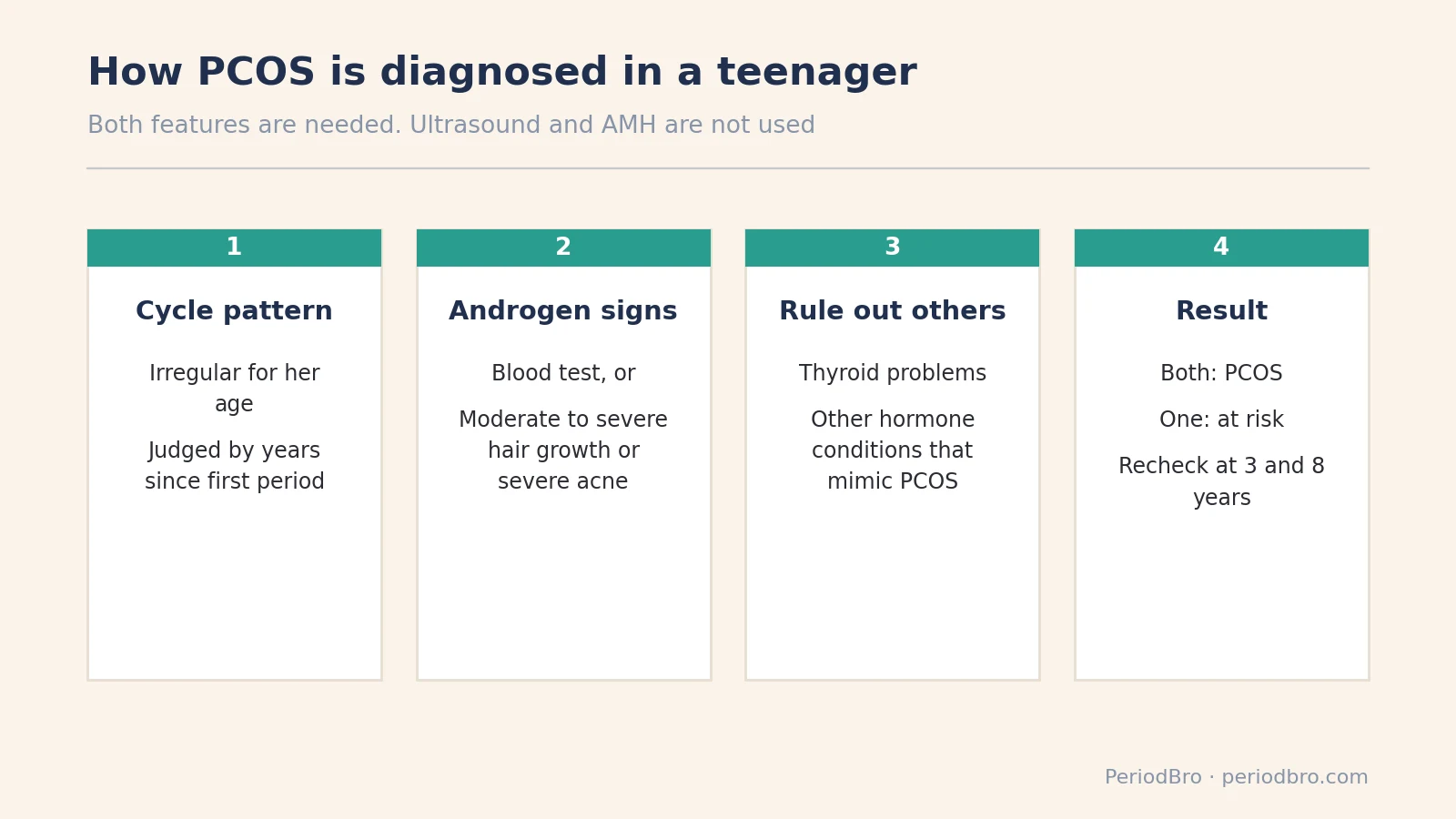
In adolescents the guideline asks for two things together: cycles that are irregular for her age, and signs of excess androgens. Those signs can show up on a blood test, or clinically as moderate to severe excess hair growth or severe acne. Doctors also rule out other conditions that look similar, such as thyroid problems. The same review says that when only one of the two is present, the label is “PCOS at risk,” and the girl is re-evaluated three years and eight years after her first period (Geburtshilfe und Frauenheilkunde, 2025).
Two things surprise parents. First, ovaries that look polycystic on ultrasound are a normal finding in adolescence, so ultrasound is used to rule out other problems, not to confirm PCOS. Second, the AMH blood test is not used to diagnose PCOS in teens, because there are no cut-off values for her age group. If a clinic offers either as the deciding test, ask why.
Acne, hair growth and how not to bring them up
Acne and extra hair both come from androgens acting on skin and hair follicles, which is why hair can appear on the upper lip, chin or chest (Center for Young Women’s Health). Plenty of teens have some of both without PCOS, so neither one proves anything. Severe acne, or hair that spreads and keeps coming back, is what makes a doctor look closer.
This is where dads trip most often. The chin-hair joke at the start of this article was meant kindly. A girl who is already hiding something she can’t control hears every comment as a verdict. A few habits that help:
- Don’t mention her skin or hair unless she does. If you’re worried, say “I’d like to get your periods checked, whenever you’re ready.”
- Leave hair removal to her. The Center for Young Women’s Health lists bleaching, waxing, laser and medication as options and calls it a personal choice.
- Skip the skin-care lectures. Acne is treated like regular acne, and it often improves once ovulation and insulin levels settle (Center for Young Women’s Health).
- Offer to pay for the dermatologist or the pharmacy run and leave it there.
Our guide to teenage acne and periods has more on separating normal breakouts from a pattern worth raising.

Weight, food and why a dad should stay out of the scale conversation
PCOS and weight are tangled together. Weight gain is a common sign, and carrying extra weight can make the hormone picture harder to manage. But the 2023 guideline also asks clinicians to explain weight-related risks to adolescents while minimizing weight stigma (BMC Medicine, 2025). The same source reports that no single diet or exercise plan has been shown to beat the others for PCOS. Teens with PCOS are also more prone to anxiety, depression and eating disorders, and the 2025 review suggests short screening tools for them (Geburtshilfe und Frauenheilkunde, 2025).
Home is where weight talk does the most damage, so change what the whole house does and say nothing about her:
- Cook meals the family likes, with protein, vegetables and whole grains, and put the same food in front of everybody.
- Pick a family activity, a walk after dinner or a weekend hike, and treat it as time together.
- Keep the scale out of conversation. Let the doctor handle weight, and ask the doctor to ask her permission first.
- Watch for skipped meals, secretive eating or panic about food. That’s a reason to tell the doctor.

What to ask the pediatrician
Start by tracking. Bring her cycle dates for the past year if she’s willing to share them, plus a short list of symptoms she’s noticed. If she’d rather keep the log herself, that’s fine. A phone note or a paper calendar works. The guide to when a girl should see a gynecologist helps if you’re unsure whether to start with her pediatrician or a specialist.
A short list to take along:
- How many years since her first period, and are her cycles irregular for that stage?
- Which other causes should we rule out, like thyroid problems or other hormone conditions?
- Does she meet both criteria, or is she “at risk,” and when do we recheck at three and eight years?
- Do you screen for anxiety, depression and eating concerns at these visits?
- What are the treatment options, and what is the evidence for them at her age?
On treatment, the 2023 guideline suggests a low-dose combined birth control pill for irregular cycles and excess androgens, and says metformin may be considered for metabolic features. The authors caution that the evidence in adolescents is limited and rated low to moderate (BMC Medicine, 2025). Decisions here are shared ones, so her voice counts. Ask for the reasoning behind any prescription. For a younger teen, the father’s role in menstrual education is a good primer on being useful without taking over.
How to support her
She might be relieved. Many teens feel better once the strange things happening in their body have a name, and the Center for Young Women’s Health suggests telling them they’re not alone and that treatment keeps improving. Let her set the pace of any conversation. If she doesn’t want to talk, offer logistics: a ride to the appointment, a seat in the waiting room, or a sit-down afterward with her favorite takeout. How to talk to your daughter about periods covers the opening lines.
The dad from the opening apologized a few weeks later. He didn’t make a speech. He said the joke was a dumb one, asked how she wanted to handle the doctor visit, and let her pick the clinic. She started eating dinner with everyone again that week. PCOS in teenage girls takes time to sort out, often years of check-ins, and a dad who stays calm and keeps his comments to himself is a real piece of the plan.
If you’d like a simple way to keep track of her cycle dates for the appointment, that’s the reason I built PeriodBro. Everything above works with a paper calendar too.
PeriodBro provides educational information and is not a substitute for professional medical advice. Always consult a qualified healthcare provider for personal medical decisions, including diagnosis and treatment of PCOS or any other condition.