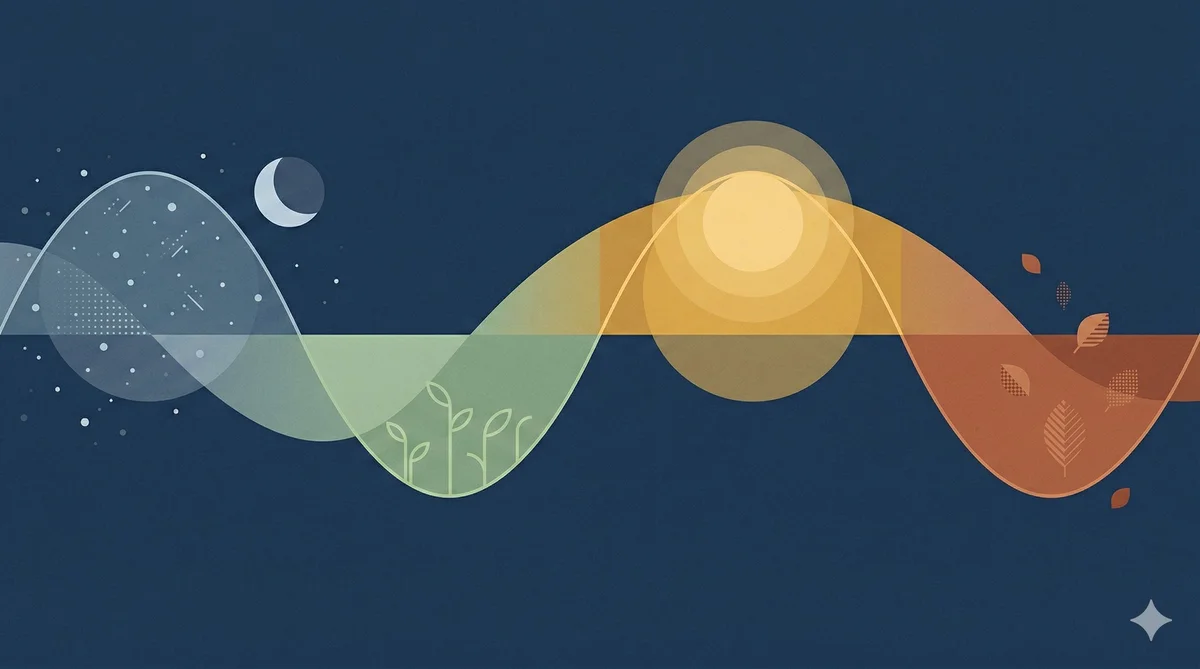
Hormones, Menstrual Cycle, Mood & Energy: How They Actually Connect (The Four Seasons Are Real)
If you’ve ever wanted a clear, partner-friendly map of how hormones menstrual cycle mood energy all connect — without medical jargon, without a pink-and-glitter wellness vibe — this is it. When I first started tracking my partner’s cycle, I thought I was being clever. I’d noticed patterns — good weeks and rough weeks — and I figured I’d just mark them in my calendar like weather forecasts.
But I didn’t really understand why the patterns existed. I knew her mood shifted. I didn’t know there were specific hormones driving those shifts in a predictable sequence, documented across thousands of research participants. Turns out, the “four seasons” metaphor we use in PeriodBro isn’t a cute marketing trick. It’s a simplified model of real endocrinology — exactly how hormones menstrual cycle mood energy and desire all link together across the month.
Here’s what the research actually says.
Hormones, Menstrual Cycle, Mood, Energy: The Short Map
If you want the headline: three hormones (estrogen, progesterone, LH) move in a predictable rhythm across four phases, and that rhythm shapes how she feels, how much energy she has, and how much she wants to be around people. The clinical names are useful but optional. The pattern is what you actually need — and below we walk through it phase by phase, with one important myth-busting detour about “brain fog.”
Four Phases, Three Hormones, One Cycle
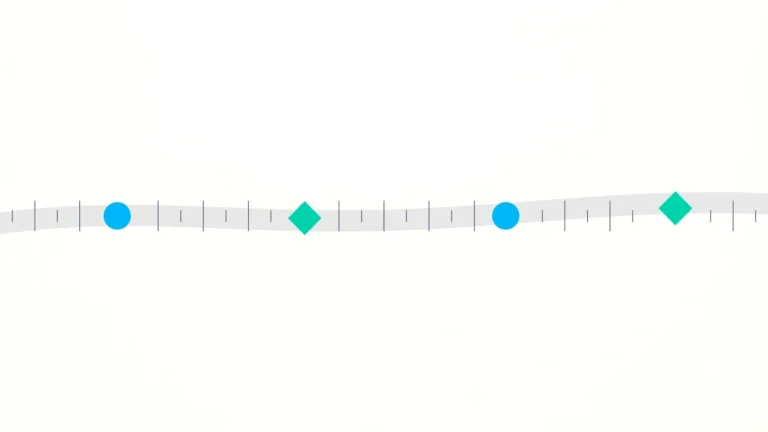
The menstrual cycle is governed by three key hormones: estrogen, progesterone, and luteinizing hormone (LH). Their levels rise and fall across four distinct phases, and each hormonal shift correlates with changes in energy, mood, social behavior, and desire. This isn’t speculation — it’s neuroendocrinology, and researchers have mapped these transitions extensively (see the NIH overview of the menstrual cycle for a clinical baseline).
Here’s the breakdown, translated into language that’s actually useful:
Winter — The Menstrual Phase (Days 1–5)
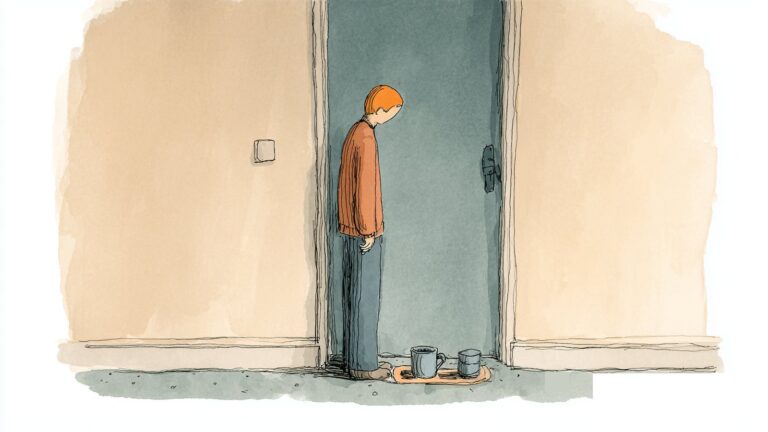
Both estrogen and progesterone drop to their lowest levels. The body is shedding the uterine lining. Women commonly report fatigue, physical discomfort, and a desire to withdraw socially. This is the phase most men are vaguely aware of — “she’s on her period” — but few understand what’s happening hormonally. It’s not just bleeding. It’s a full hormonal reset. Her body is at its lowest energy baseline, and the instinct to rest is biological, not dramatic.
Spring — The Follicular Phase (Days 6–13)
Estrogen starts climbing. Energy returns. Confidence builds. Women in this phase often report feeling more optimistic, more social, and more willing to take on new challenges. This is the phase where she wants to make plans, start projects, say yes to things. If you’ve ever noticed a week where everything just flows between you — conversations are easy, laughter comes naturally, she seems lighter — this is likely why.

Summer — The Ovulatory Phase (Days 14–16)
The LH surge hits its peak. Estrogen is at maximum. This is the shortest phase — roughly two to three days — but it’s the most noticeable. Research documents increased social engagement, heightened confidence, and high physical energy. From a biological standpoint, this is the fertility window, and the body is in an outward-facing mode. She may seem more talkative, more affectionate, more present. It’s not a performance. It’s biology doing exactly what it’s built to do.
Autumn — The Luteal Phase (Days 17–28)
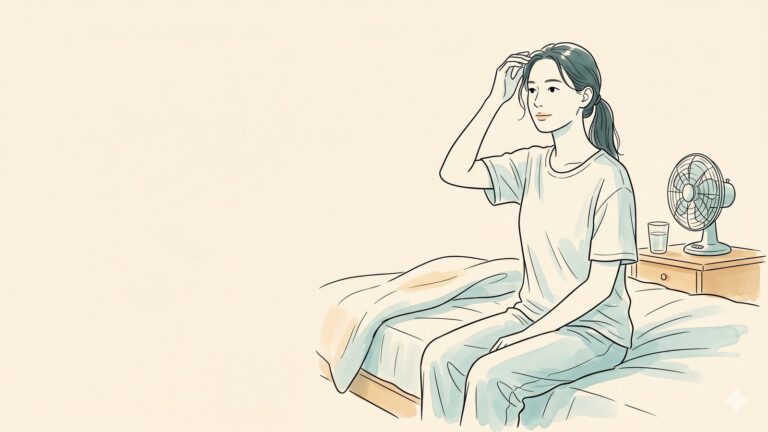
Progesterone takes over as the dominant hormone. Estrogen starts declining. This is the longest phase — nearly two weeks — and it’s the one that catches most men off guard. The shift is gradual at first: she turns inward, becomes more reflective, may prefer quiet evenings over social plans. Toward the end of this phase, as progesterone drops sharply before menstruation, many women report irritability, heightened emotional sensitivity, and what’s commonly described as “brain fog.”
Which brings us to the most important finding in this entire article.
The “Brain Fog” Myth: What 102 Studies Actually Found About Hormones, Menstrual Cycle, Mood and Energy
Let’s talk about the single biggest misconception men have about how hormones menstrual cycle mood energy interact: that the cycle makes women less sharp.
In 2025, researchers Jang et al. published a meta-analysis that synthesized 102 studies, covering 3,943 participants and 730 direct comparisons of cognitive performance across cycle phases. The question was straightforward: does the menstrual cycle actually impair attention, memory, creativity, or intelligence?
The answer: no.
The meta-analysis found no robust evidence for significant cognitive shifts at any point in the cycle. Not during menstruation. Not during the luteal phase. Not anywhere. Response speed didn’t change. Accuracy didn’t change. The “menstrual brain fog” that millions of people believe in — including many women themselves — is not supported by objective cognitive testing.
So why does it feel real?
Two reasons. First, the subjective experience of fatigue and discomfort during certain phases is genuine — pain and low energy make everything feel harder, even when your actual cognitive output hasn’t declined. Second, retrospective recall bias. When people expect to perform worse during their period, they remember confirming examples and forget contradicting ones. The researchers specifically noted that self-reported symptoms consistently exaggerated what objective tests measured.
Here’s why this matters for you as a partner: her feelings during autumn and winter are real. Her capacity isn’t diminished. These two things can coexist. When you treat her like she’s temporarily less capable — taking over decisions, speaking for her, dismissing her opinions as “hormonal” — you’re acting on a myth. When you acknowledge that she’s uncomfortable while trusting her competence, you’re acting on science.

Why We Built the Cycle Wheel Around This
When I designed the Cycle Wheel in PeriodBro, I didn’t want another clinical chart with hormone curves that nobody outside a lab would understand. I wanted something a man could glance at during his morning coffee and immediately know: what season is she in today, and what does that mean for how I show up?
The seasonal metaphor works because it captures the quality of each phase, not just the biology. Winter isn’t “menstruation” — it’s rest, quiet, turning inward. Spring isn’t “follicular” — it’s renewal, rising energy, openness. You don’t need to remember which hormone peaks when. You need to recognize the season and adjust how you respond to her shifting mood and energy.
But underneath that simple interface is the endocrinology we just walked through. The Cycle Wheel is calibrated to the hormonal transitions documented in peer-reviewed research. It’s not vibes. It’s not astrology for couples. It’s a translation layer between clinical science and daily life — a single screen that maps hormones menstrual cycle mood energy and desire to today’s actions.
What the Research Doesn’t Say
A few honest caveats, because credibility matters more than confidence.
The Jang meta-analysis noted a “small-study effect” — most existing research used small sample sizes, averaging just 39 participants per study. The conclusion isn’t “the cycle definitely has zero cognitive effects.” It’s “with the evidence we have, there’s no robust support for the impairment narrative.” Larger studies may reveal subtle variances. But even if they do, those variances won’t justify the stereotype of women being mentally unreliable for two weeks every month.
Also: every woman’s cycle is different. The four-phase model describes a typical 28-day cycle, but real cycles range from 21 to 35 days. Stress, sleep, medication, illness, and age all shift the pattern. The Cycle Wheel in PeriodBro adapts to her actual cycle length, not a textbook average — because the science is only useful when it maps to her specific reality.
The Takeaway
The four seasons of her cycle are driven by measurable hormonal shifts — estrogen, progesterone, and LH rising and falling in a documented sequence. These shifts correlate with real changes in energy, mood, and social behavior. They do not correlate with cognitive decline, despite what cultural stereotypes suggest.
Understanding how hormones menstrual cycle mood energy and desire are linked changes how you respond. Instead of guessing why she’s withdrawn or wondering what you did wrong, you have a framework. Not to predict her — she’s not a weather app — but to understand the biological context she’s navigating. And to show up accordingly.
That’s what the Cycle Wheel does. Science, simplified. Delivered daily. So you can be the partner who gets it.
Sources: Jang et al. (2025), “Menstrual cycle effects on cognitive performance: a meta-analytic review,” 102 studies, 3,943 participants. NIH/NICHD overview of the menstrual cycle. Hennegan et al. (2021), WHO MHH definitional consensus.
For how all of this fits together across the whole month, see our complete menstrual cycle guide for men.