What Is the Menstrual Phase? How to Support Her Right Now
What is the menstrual phase? It’s the first 3-7 days of her cycle, when the uterine lining sheds and estrogen + progesterone hit their lowest point of the month — and the days where your partner most needs you to dial down friction without making a show of it.
She put a heating pad on the couch and didn’t say anything about it. I noticed it the way you notice a quiet weather change — not as a complaint, not as an event, just as new information about the room. It was her day one.
For years, I had thought of “her period” as a single state — a week she was less herself and I was supposed to be quieter. What I didn’t understand, until I actually sat with the biology, was that day one and day five are not the same day. They’re not even the same body. And the man who reads “she’s on her period” as one flat fact for five days is going to be wrong about her for almost the entire week.
This is a field guide to what’s actually happening in her body during the menstrual phase — the bleed itself — and what aligning with that looks like instead of just enduring it together.
What Is the Menstrual Phase, Actually?
The menstrual phase is the first phase of her cycle: typically days one through five, sometimes stretching to seven. Day one is, by definition, the first day of full flow. (NCBI / StatPearls — Physiology, Menstrual Cycle)
What’s happening underneath is a chain of events that started the day before. At the very end of the previous month’s luteal phase, estrogen and progesterone — the two hormones that had been keeping the uterine lining built up and ready for a possible pregnancy — drop sharply. There’s no pregnancy. The lining is no longer needed. The body responds by shedding it.
That shedding is not a passive process. To peel the lining off, the body releases prostaglandins, hormone-like compounds that make the spiral arteries in the uterus constrict, spasm, and break apart. That’s the mechanism behind cramps. Cramps are not “she’s in pain.” Cramps are her uterus actively contracting — comparable, in some women on the heavier end, to mild labor contractions. (Same source.)
The total blood loss over the five-day average is about 30 to 60 mL — roughly two to four tablespoons. Doesn’t sound like much. But each milliliter of blood carries about 0.5 mg of iron, which means a typical period drains 15 to 30 mg of iron from her system. (Eureka Health — iron loss in menstruation) If her period is heavier than 80 mL, the iron loss can push her into iron deficiency, which is one of the most common causes of fatigue in menstruating women. (PMC — heavy menstrual bleeding & iron deficiency)
In other words: the tiredness she has on day two isn’t mostly in her head. Some of it is a literal blood and iron deficit moving through her bloodstream in real time.
The three things she’s running on empty for
If you want a quick mental model, here’s the one I use. During the menstrual phase, three resources in her body are simultaneously low:
1. Hormones. Both estrogen and progesterone are at their lowest point of the entire cycle. Estrogen, in particular, normally supports serotonin and dopamine availability — so when it bottoms out, mood and energy take a parallel dip. This isn’t “weakness.” It’s the floor of the hormonal month.
2. Iron. The body is actively losing blood, and iron is leaving with it. By day two or three, iron stores in some women dip enough to register as real, measurable fatigue. (PMC — diagnosis & management of iron deficiency in females)
3. Sleep. The drop in progesterone — which has a mildly sedating effect — combined with prostaglandin-driven discomfort often means her sleep the night before day one and through the first two days is genuinely worse. She’s running on a smaller battery and a worse charge.
Three deficits at once. None of which she’s choosing. None of which she has to apologize for.

What “supporting her right now” actually looks like
There’s a version of being supportive during the menstrual phase that is mostly theater. The man performing concern. The constant “are you okay?” every twenty minutes. The dramatic offering of solutions. None of that is what’s needed, and most women find it exhausting in its own right.
What actually works is closer to quietly removing friction.
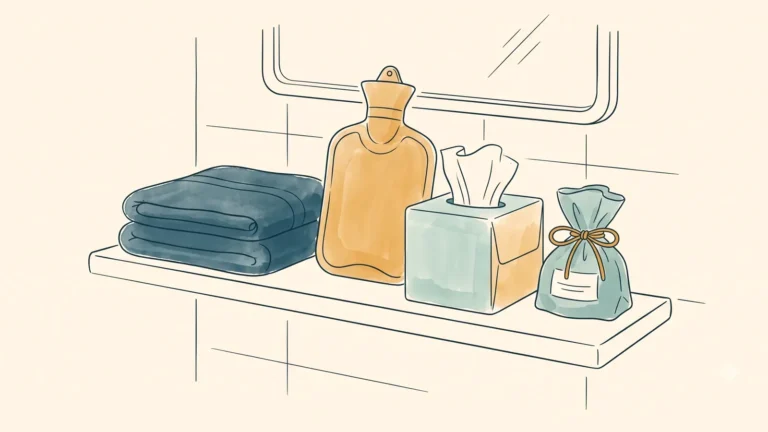
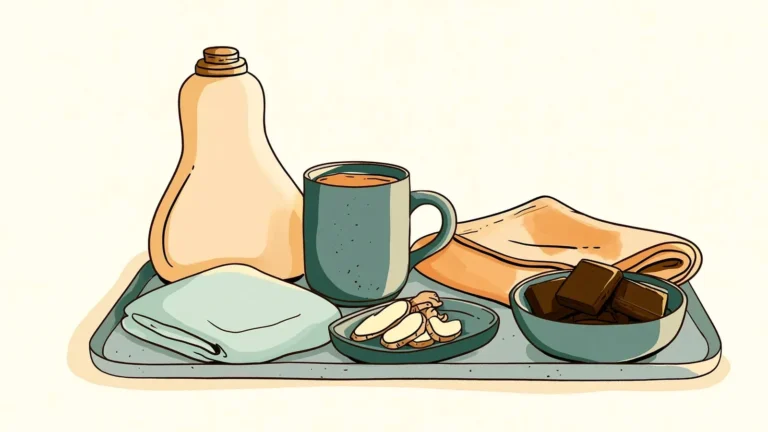
Make the easy things easier. A glass of water she didn’t have to get up for. The good blanket already on the couch. A heating pad in the place where the cramps usually land (lower belly or lower back). Her go-to snack already in the kitchen. None of this is heroic. All of it lowers the cost of being a person in her own house on a low-resource day.
Don’t make her hostess. If you have friends coming over, plans you scheduled, things you committed to as a couple — be the one who carries them. Don’t ask her to be the social engine on day one. If she wants to opt out of something, the answer is yes, no questions, no negotiation. This isn’t pampering. It’s reading the energy budget honestly.
Take “I’m fine” at face value, but check once. She might genuinely be fine. She might also be the kind of person who says she’s fine because she’s tired of asking for things. The rule: ask once, with no big production, then drop it. “Do you want anything before I sit down?” — said in passing, not as a Big Moment — usually gets a real answer.
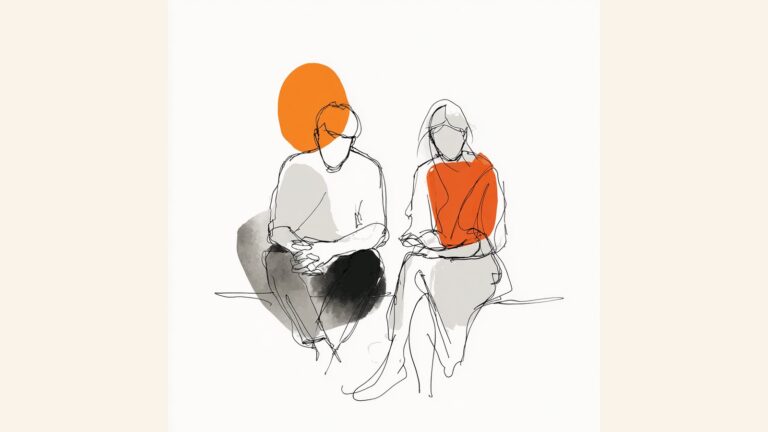
Don’t disappear and don’t hover. Day one is not the day for a long heart-to-heart, and it’s not the day to retreat into your phone for six hours. Be in the room. Be quiet. Watch something together that doesn’t require either of you to perform.
The trap: pretending it’s not happening, or over-narrating it
There are two failure modes most partners cycle through before landing on the right move.
The first is pretending it’s not happening. Acting normal, asking why she’s tired, expecting the same energy on day two as day fourteen. This signals that her body’s reality is inconvenient to you. Even if it’s unspoken, she’ll feel it.
The second is over-narrating it. Constantly mentioning that she’s on her period, framing every mood as PMS, making jokes about it, performing knowingness. This is just as bad — it reduces her to her cycle, makes her self-conscious, and gives her a reason to be irritated at you specifically.
The right register is somewhere in between: I know what’s happening. I’ve factored it in. I’m not going to mention it. The information shapes your behavior. It doesn’t become the topic of conversation.
Day one is not day five
A useful refinement: the menstrual phase is not flat.
Days one and two are usually the hardest. Bleeding is heaviest, prostaglandins are highest, cramps peak. Energy is at its lowest. This is the part where “remove friction, don’t perform” is the entire job.
Days three to five are different. Bleeding tapers. Prostaglandins fall off. Estrogen starts to climb again as the next follicular phase begins ramping up — and most women feel a meaningful lift in mood and energy somewhere between day three and day five. By day five she may be ready to do things she didn’t want to do on day one.
If you treat all five days as “she’s on her period, walk carefully” you’ll be reading day four wrong. The skill is calibration: low-touch on days one and two, normal-with-attention on days three to five.

The long game: what you do on day 25 changes day 1
Same principle as we wrote about for the luteal-phase fights — the menstrual phase doesn’t get built in the menstrual phase. It gets built in the week before.
If days 22-28 were heavy on conflict, low on sleep, low on real food, low on rest — day one is going to land twice as hard. If the late luteal week was navigated with some intention — earlier bedtimes, a bit more iron-rich food, fewer arguments left unaddressed — the body comes into day one with a slightly better starting position. None of this prevents the menstrual phase from happening. It just lowers the cost of the landing.
The American College of Obstetricians and Gynecologists calls the menstrual cycle the “fifth vital sign” — meaning a regular, well-tolerated cycle is one of the most accessible windows into a woman’s overall health. (ACOG — Menstruation as a Vital Sign) Living with someone whose body runs on a 28-day pattern and treating that pattern as background noise — that’s a wasted dataset. Tracking it, with her consent, is mostly a way to stop being surprised by something that’s been arriving on roughly the same date for years.
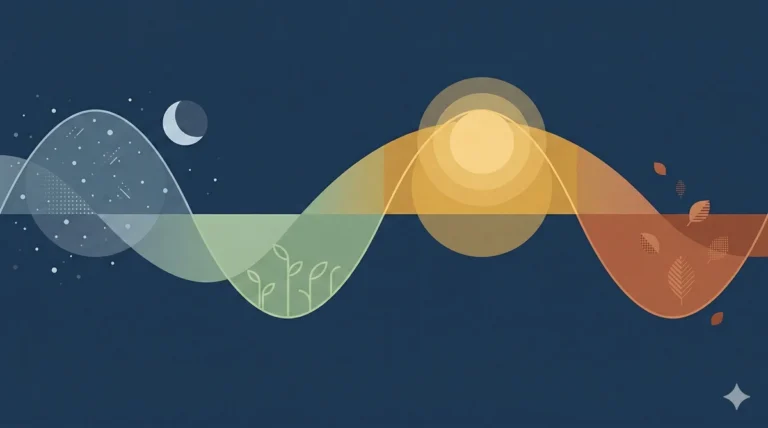
If you want the broader map of the cycle, Menstrual Cycle Phases Explained for Men is the four-phase field guide. If you want a tactical layer for day one — what to actually hand her, what to put in the bag, what to do about the cramps specifically — How to Help Girlfriend with Period Cramps is the operational sibling to this article. And PeriodBro is the daily nudge so you don’t have to keep the calendar in your head — most men we hear from say the biggest change isn’t doing dramatic new things, it’s not being caught off guard by an arrival they should have seen coming.
Day one will keep coming. The question is whether it keeps catching you.
Menstruation is the opening phase – the complete sequence is covered in our complete menstrual cycle guide for men.