4 Seasons of Menstrual Cycle for Men: A Field Guide (Winter/Spring/Summer/Autumn)
The 4 seasons of menstrual cycle for men is the model I wish someone had drawn for me on a napkin twenty years earlier. Winter, spring, summer, autumn — four different versions of the woman you love, all of them real, all of them her. No pink charts, no medical-textbook language, no apologies. Just one man’s working map of what’s happening inside your partner across the month, and what you can do about it.
I didn’t know what “luteal phase” meant until I was 35.
I’d been in relationships. I’d been married. I’d become a father. And I still couldn’t tell you the difference between ovulation and menstruation. Not because I didn’t care — because no one ever told me I should know.
Then I started dating someone whose mood shifted like weather. Happy and flirty one week, quiet and withdrawn the next. I thought it was about me. About us. I’d ask what was wrong, and she’d say “nothing” — which, as every man eventually learns, rarely means nothing.
It took me embarrassingly long to connect the dots. Her energy, her patience, her desire for closeness or space — it was all moving in a pattern. A roughly 28-day pattern that nobody had ever drawn on a napkin for me. The whole point of framing the 4 seasons of menstrual cycle for men is to skip the years it took me to figure that out.
So here it is. The napkin. The guide I wish someone had handed me at 20. Just one man explaining to another what’s actually going on inside the person you love — and what you can do about it.
4 Seasons of Menstrual Cycle for Men: The Map at a Glance
If you only remember one thing about the 4 seasons of menstrual cycle for men, remember this: it’s four seasons, not four switches. Winter is rest. Spring is rising. Summer is peak. Autumn is winding down. Each one lasts a different length, and each one calls for a different version of you. Below we walk through each in plain language, plus a one-screen cheat sheet at the end.
(Want the more clinical breakdown — phase-by-phase with hormone names, FSH/LH, exact day windows? See menstrual cycle phases explained for men. This article is the field-guide voice version; that one is the diagram. Pick whichever lands better.)
Why “Seasons” and Not “Phases”
Doctors call them the menstrual phase, follicular phase, ovulatory phase, and luteal phase. Which is great if you’re studying for a biology exam, but terrible if you’re trying to remember what to do on a Tuesday night when she’s crying over a cat video.
Seasons work better. Everyone understands seasons. You know winter requires a different approach than summer. You don’t fight the weather — you dress for it. Same principle here.
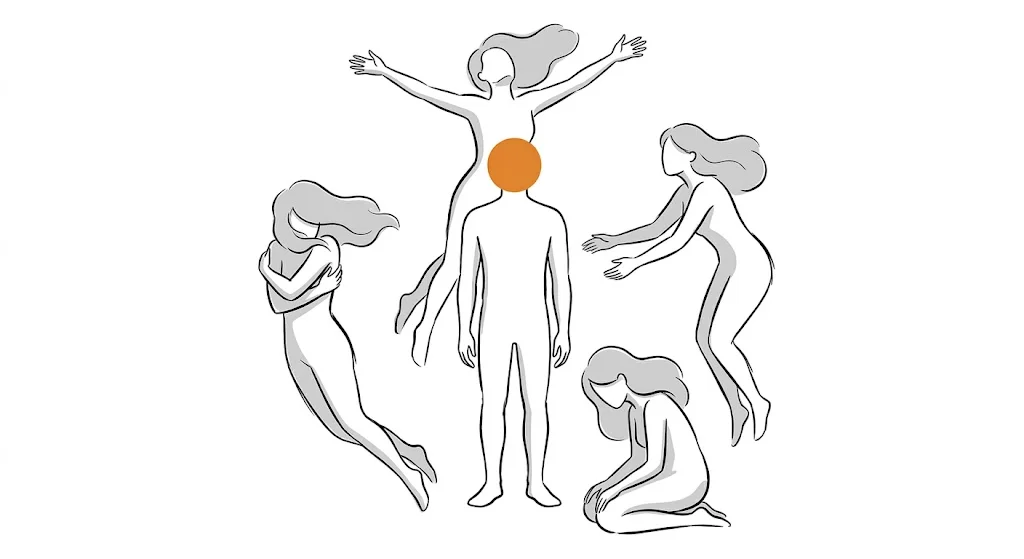
Her cycle is roughly 28 days. Some women run 25, some run 32, and that’s normal (ACOG: 21–35 days is the typical adult range). But the pattern — the emotional and physical rhythm — is remarkably consistent. Four phases. Four seasons. Four different versions of the woman you love, all of them real, all of them her.
Let’s walk through them.

Winter: Menstruation (Days 1–5)
What’s happening inside her body: The uterine lining is shedding. Estrogen and progesterone are at their lowest point. Her body is doing physical work — and it’s exhausting. Many women experience cramps (which range from mild discomfort to genuinely debilitating pain), headaches, fatigue, and bloating.
What she might feel: Think of it as the body’s reset button. Energy is low. Social battery is drained. She might want to cancel plans, stay in, and just be left alone with a blanket and something warm. Some women feel relief — the tension of the pre-period days is finally over. Others feel fragile. Both are valid.
What you can do:
- Lower the bar. This is not the week to suggest a dinner party with your college friends. If she wants to stay in, stay in with her. Or give her space — but make it clear it’s space you’re offering, not distance you’re creating.
- Handle the logistics. Cook dinner. Walk the dog. Don’t wait to be asked — just do it. One of the most powerful things a partner can do during winter is quietly reduce the number of decisions she needs to make.
- Stock the basics. Know her preferred pain relief (ibuprofen works better than acetaminophen for cramps, by the way — it reduces inflammation, not just pain). Have a heating pad accessible. Keep her favorite comfort snacks in the house.
- Don’t ask “Are you on your period?” as a diagnosis. If she’s upset about something, take it at face value. Even if hormones are amplifying it, the feeling is real. Nothing kills trust faster than dismissing her emotions as symptoms.
Winter survival rule: Be warm. Be quiet. Be useful.
Spring: The Follicular Phase (Days 6–13)
What’s happening inside her body: Estrogen starts climbing. Estrogen supports higher serotonin and dopamine activity in the brain — modulating them rather than directly producing them. A new egg is maturing. Her body is preparing, building, getting ready. It’s biological optimism — her system is gearing up for possibility.
What she might feel: This is the “good week” that most men notice without understanding why. She’s more energetic, more social, more creative. She might suggest a trip, start a new project, or suddenly want to rearrange the living room at 9 PM. Her confidence rises. She laughs easier. She initiates more — conversations, plans, intimacy.
What you can do:
- Match her energy. She’s up — don’t drag her down. If she wants to try that new restaurant, say yes. If she pitches a weekend idea, lean in. Spring is your window for the fun stuff you’ve been putting off.
- Plan forward. This is actually the best time to have big conversations — about finances, about plans, about that thing that’s been bugging you. Her emotional bandwidth is at its highest. She’s more likely to engage constructively rather than defensively.
- Notice out loud. “You seem really happy today” or “I love when you get excited about stuff like this.” She may not know why she feels great. Reflecting it back makes her feel seen — and subtly teaches both of you to recognize the rhythm.
Spring rule: Say yes. Plan things. Ride the wave with her.
Summer: Ovulation (Days 14–16)
What’s happening inside her body: Estrogen peaks. Testosterone spikes briefly. An egg is released. Biologically, this is the main event — everything in her body has been building toward this moment. Luteinizing hormone surges, triggering ovulation within 24–36 hours.
What she might feel: Subjectively, many women feel more confident and energetic around ovulation, and some research links this to estrogen’s peak. Her communication can feel sharper. Her libido is often at its highest. She might be more flirty, more affectionate, more “on” than at other times of the month. (Individual variation is large — this is a pattern, not a guarantee.)
What you can do:
- Show up fully. This is not the week to be glued to your phone or distracted by work. She’s radiating energy — and she’ll notice if you’re not receiving it. Eye contact. Full attention. Be present.
- Initiate connection. Don’t just wait for her to come to you. Plan a date. Send a message in the middle of the day. Physical touch goes a long way during summer — not because she “needs” it hormonally, but because she’s in a space where she deeply enjoys it.
- If you’re trying to conceive: You probably already know this, but ovulation is the window. If kids are on the horizon, this is the biological moment. If they’re not, this is worth being aware of for contraception reasons too.
Summer rule: Be present. Be bold. Enjoy the peak together.

Autumn: The Luteal Phase (Days 17–28)
What’s happening inside her body: Progesterone rises, then declines as the phase progresses. If the egg wasn’t fertilized, the body starts preparing to shed the lining again. Estrogen also rises and falls. The late-luteal mood symptoms most men notice are associated with the drop of progesterone (and its calming metabolite, allopregnanolone), not its peak. The second half of the cycle feels more volatile because the hormonal landscape is genuinely shifting.
What she might feel: The first few days of autumn (days 17–21 or so) might feel fine. But as the phase progresses, PMS symptoms can appear: irritability, bloating, tender breasts, cravings, anxiety, insomnia, emotional sensitivity. The severity varies wildly — some women barely notice it, others go through genuine psychological distress. About 3–8% of women experience PMDD (Premenstrual Dysphoric Disorder), which is a clinical condition, not just “bad PMS.”
Here’s what’s important: her emotions during autumn are real. Hormones don’t create feelings from nothing — they amplify what’s already there. If she’s irritated about dirty dishes, the irritation is real. The dishes are real. Progesterone is on its way down, and her brain reacts to the shift.
What you can do:
- Don’t take the bait. This is the hardest part for most men. She might pick a fight about something small. She might cry over something that wouldn’t normally bother her. Your job is not to fix, debate, or rationalize. Your job is to not escalate. Take a breath. Listen. Say “I hear you.” That’s usually enough.
- Reduce friction proactively. If you know what triggers stress in your household — dishes, laundry, meal planning, kid logistics — handle it before she has to ask. During autumn, her capacity for tolerating friction is lower. Removing it is one of the most loving things you can do.
- Adjust expectations. Don’t plan a surprise party. Don’t bring up the budget. Don’t suggest she’s “overreacting.” Save the heavy conversations for spring. Right now, be the person who makes life a little easier, not harder.
- Watch for PMDD. If her symptoms go beyond “irritable” into territory that looks like depression, panic attacks, or emotional crisis — every single cycle — that might be PMDD. It’s real, it’s medical, and it’s treatable. Gently suggesting she talk to her doctor isn’t overstepping. It’s caring.
Autumn rule: Don’t escalate. Don’t debate. Just be steady.
The Cheat Sheet You’ll Actually Use
Here’s the entire 4 seasons of menstrual cycle for men on one screen. Screenshot it. Bookmark it. Whatever works.
| Season | Days (approx.) | Her Energy | Your Move |
|---|---|---|---|
| 🌨️ Winter | 1–5 | Low, resting | Be warm, be quiet, be useful |
| 🌱 Spring | 6–13 | Rising, optimistic | Say yes, plan things, ride the wave |
| ☀️ Summer | 14–16 | Peak confidence | Be present, be bold, enjoy it |
| 🍂 Autumn | 17–28 | Declining, sensitive | Don’t escalate, be steady |
But Wait — Her Cycle Isn’t Exactly 28 Days
Right. And that’s the thing about field guides — they describe the terrain in general, not the exact rock you’ll trip over.
Your partner’s cycle might be 26 days or 33 days. Her spring might last a week or three days. Her autumn might start with a bang or a slow simmer. Stress, sleep, travel, birth control, illness — all of these can shift the pattern.
That’s why awareness alone isn’t enough. You need to track. Not obsessively, not secretly — but consistently and with her knowledge. When you know she’s on day 22, you’re not guessing why she’s distant. You have context. And context transforms a confused “what did I do wrong?” into a calm “ah, autumn — I’ll handle dinner tonight.”
This is what turned things around for me. Not reading one article. Not having one good conversation. But seeing the pattern repeat, month after month, and finally understanding that her changes weren’t chaos — they were rhythm. Predictable, manageable, beautiful rhythm.
What This Means for You — Right Now
If you’ve made it this far, you already know more about the 4 seasons of menstrual cycle for men than most guys will learn in a lifetime. That’s not an exaggeration. Most men never Google this. Most men never ask.
You did. That means something.
Here’s what I’d suggest as a next step: figure out what season she’s in today. You might already have a rough idea. If you don’t, ask her — “Hey, I’ve been reading about how I can be a better partner during your cycle. Can you tell me where you’re at right now?” Most women will be surprised. Many will be touched. Some might laugh. But almost none will be offended by a man who’s trying to understand rather than avoid.
You don’t need to memorize hormone names. You don’t need to become a gynecologist. You just need to care enough to notice the seasons change — and adjust how you show up.
That’s it. That’s the whole skill.
And once you have it, you can’t unsee it. Conversations make more sense. Fights that used to blindside you become predictable. The good weeks become something you consciously enjoy instead of taking for granted. You stop reacting to her moods and start anticipating her needs.
That’s not manipulation. That’s not “tracking her like a project.” That’s what being a conscious partner looks like.
Welcome to the field guide. Seasons change. Be ready.
(If you want the diagram-and-hormone-names version of all this, the companion piece is menstrual cycle phases explained for men — same map, different angle.)

The seasons model is one lens; for the full end-to-end picture see our complete menstrual cycle guide for men.